Over the past year I’ve been doing a lot of reflecting on what my life is like now and what I’d like it to look like five years from now. As it is with most people, a lot has happened in the past four years. In 2020 I became single for the first time in 10 years, oh, and it was COVID, and meeting people became a challenge for everyone, but especially someone working at a tiny software firm and living alone. Then my 30th birthday came around, and I had a lot of feelings about being 30, single, and having very little success from online dating…
But the biggest shock for me personally was last summer when I got shingles on the right side of my face and was confronted with the possibility of losing my vision. That was pretty terrifying. Now, I’m fully recovered from shingles, but my body is still in a constant stress response (new eczema has appeared! and my OCD is on fire!), and I know the way I’ve been living isn’t sustainable for me.
I’ve been looking at a lot of farms and artists I admire and am really thinking about what I would be doing every day if money was no object. I’m hoping that there is a way to meet in the middle – be able to have a sustainable income for myself, my partner, and a future family someday, but also be able to spend more time on the things I enjoy without it feeling like I’m working 3 jobs.
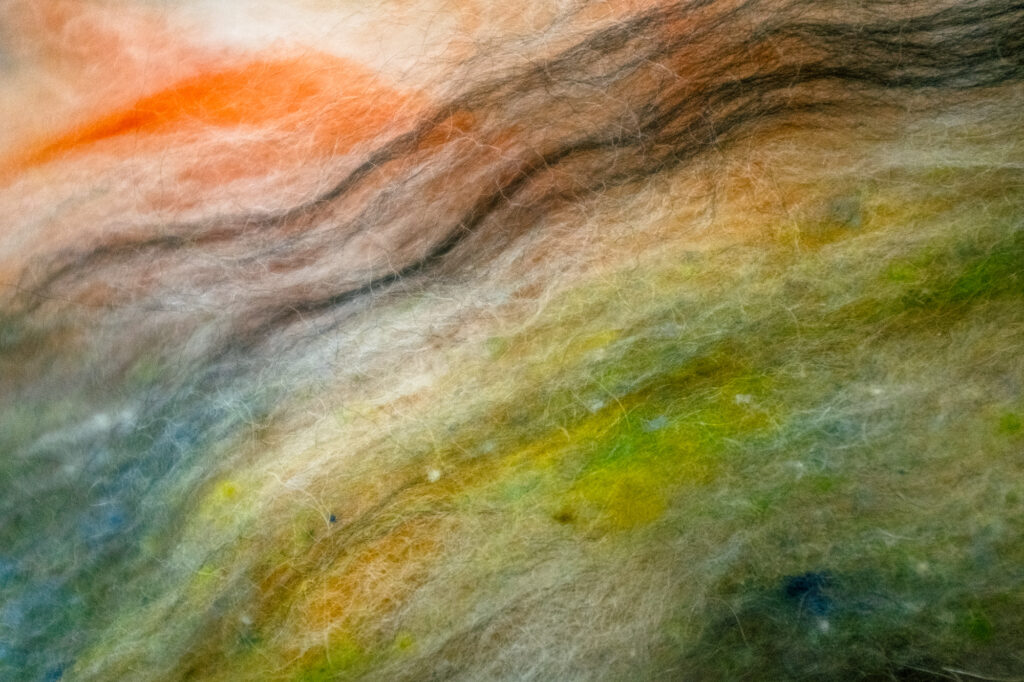
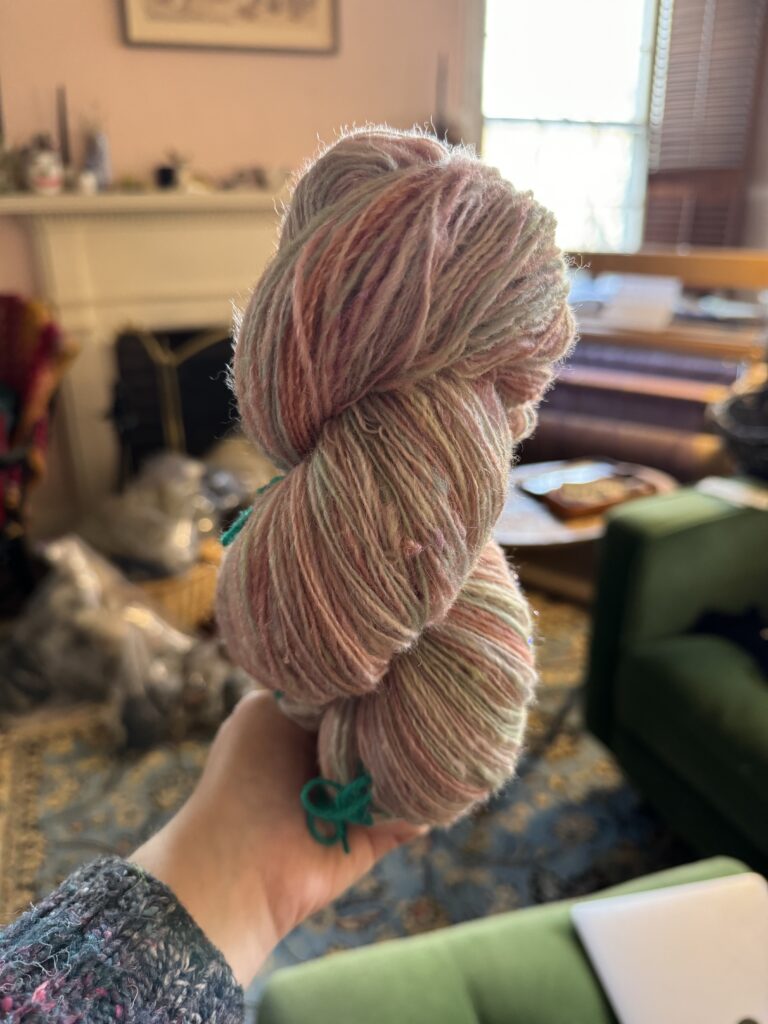
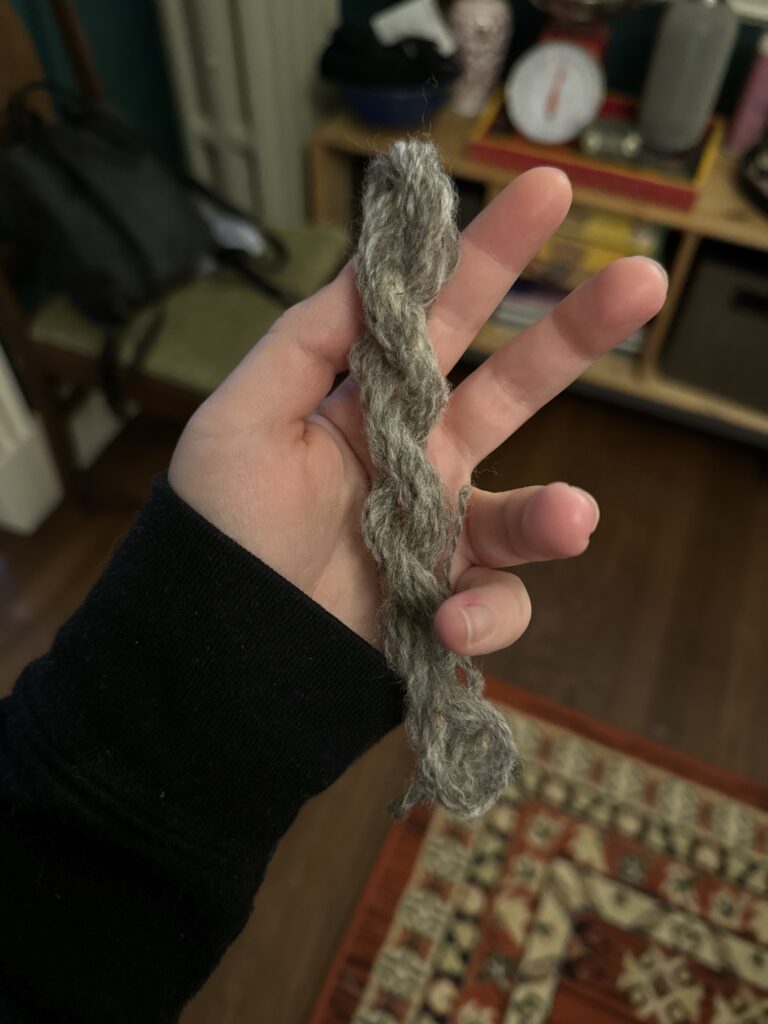
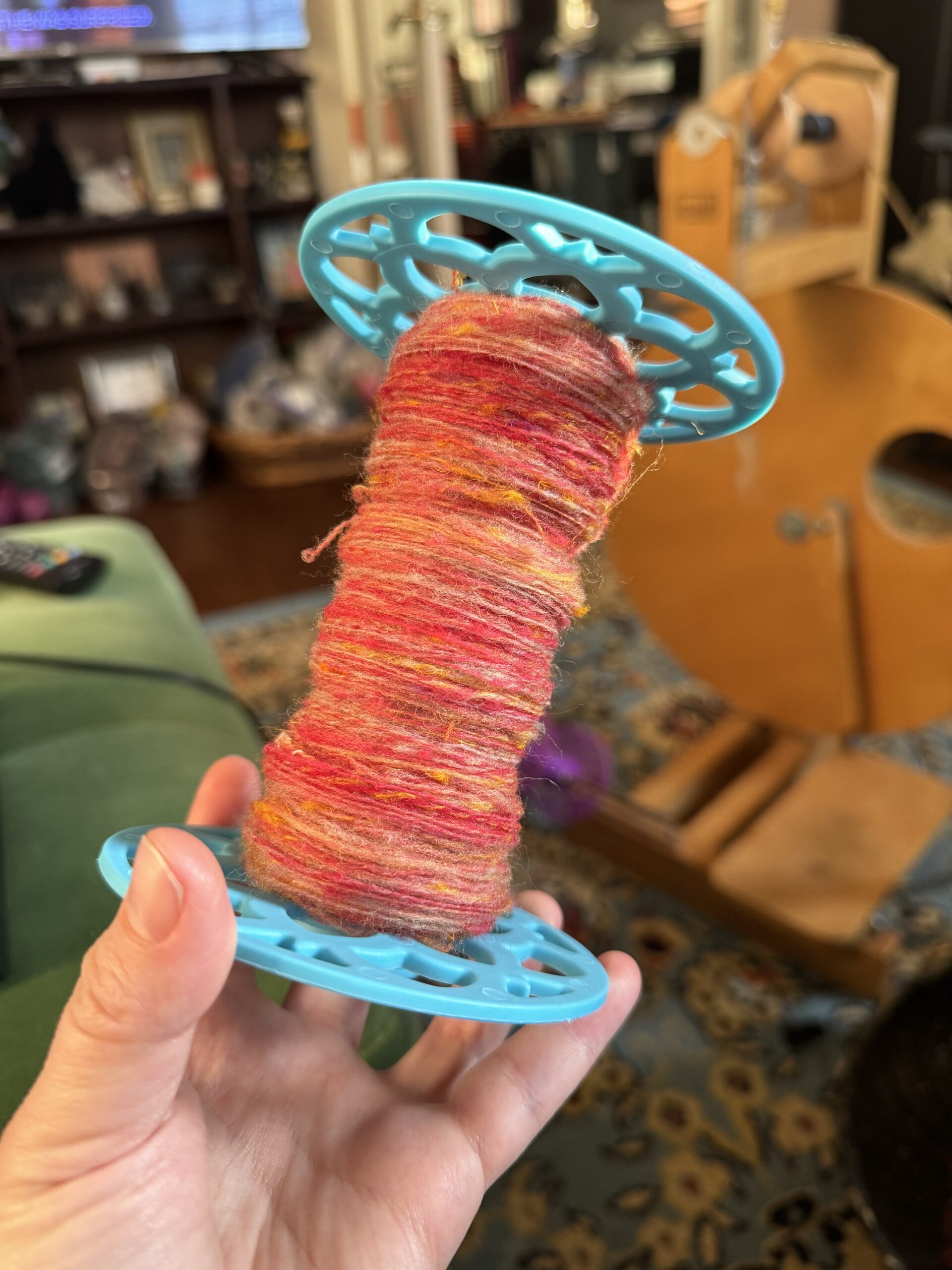
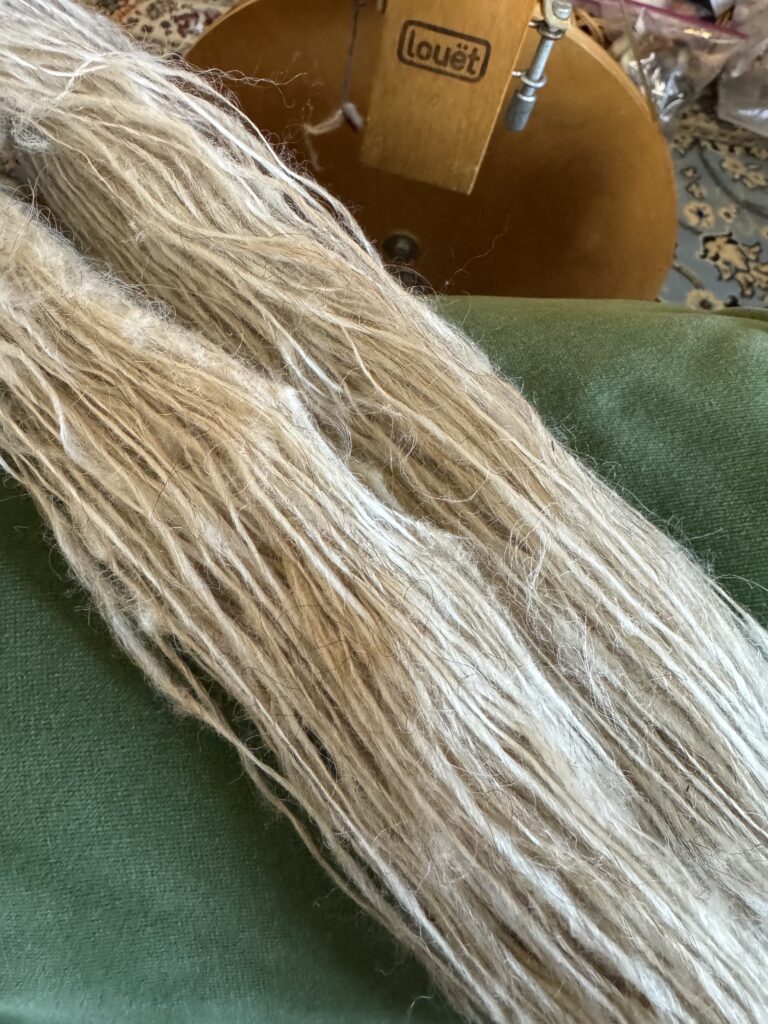
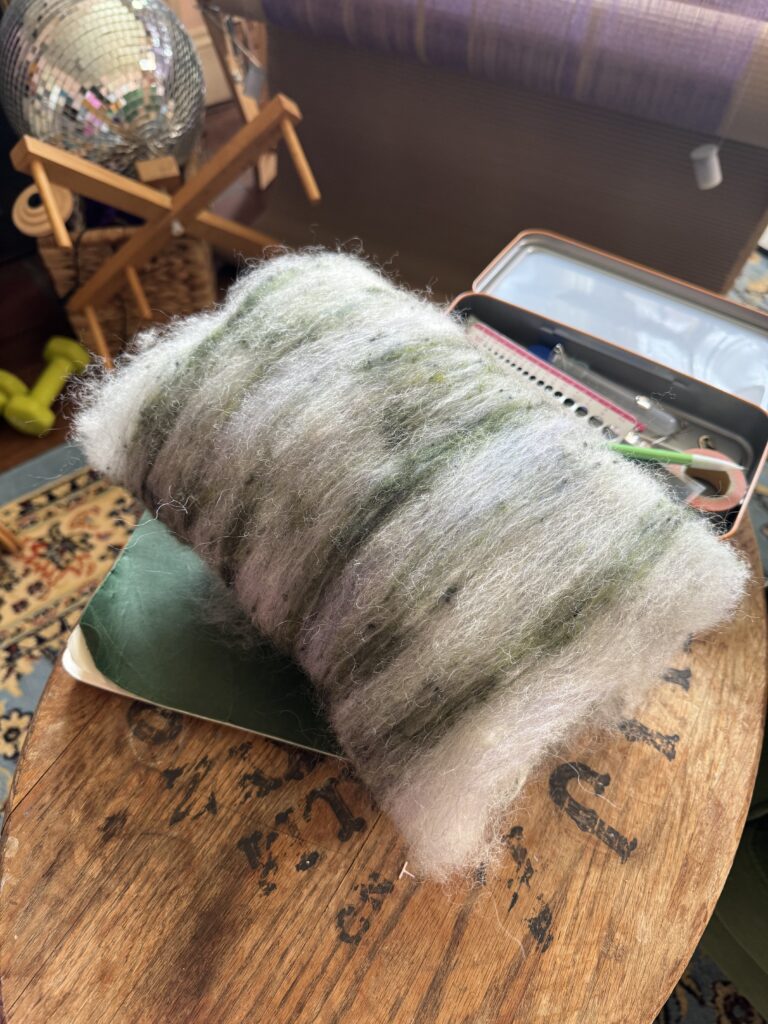
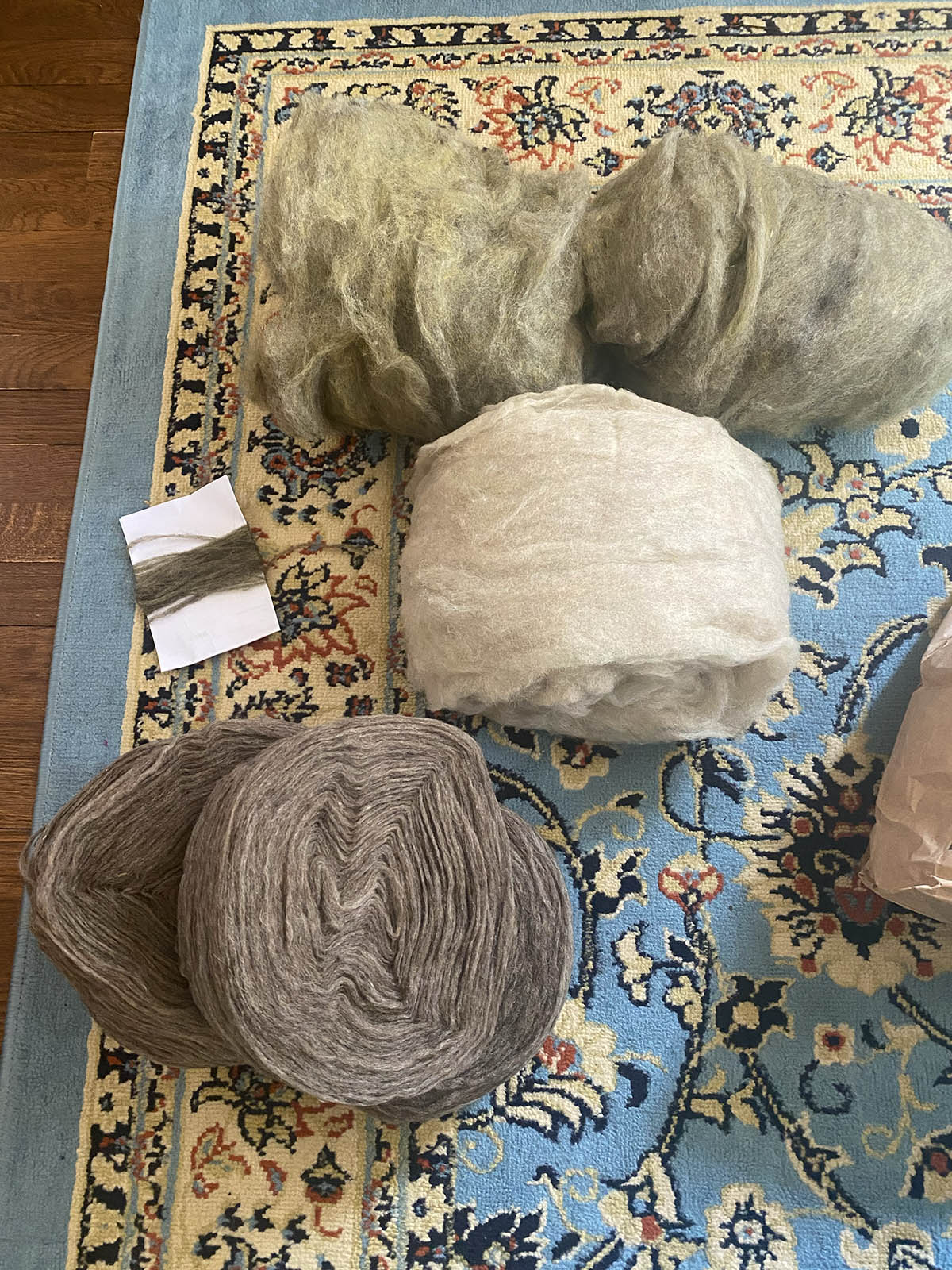
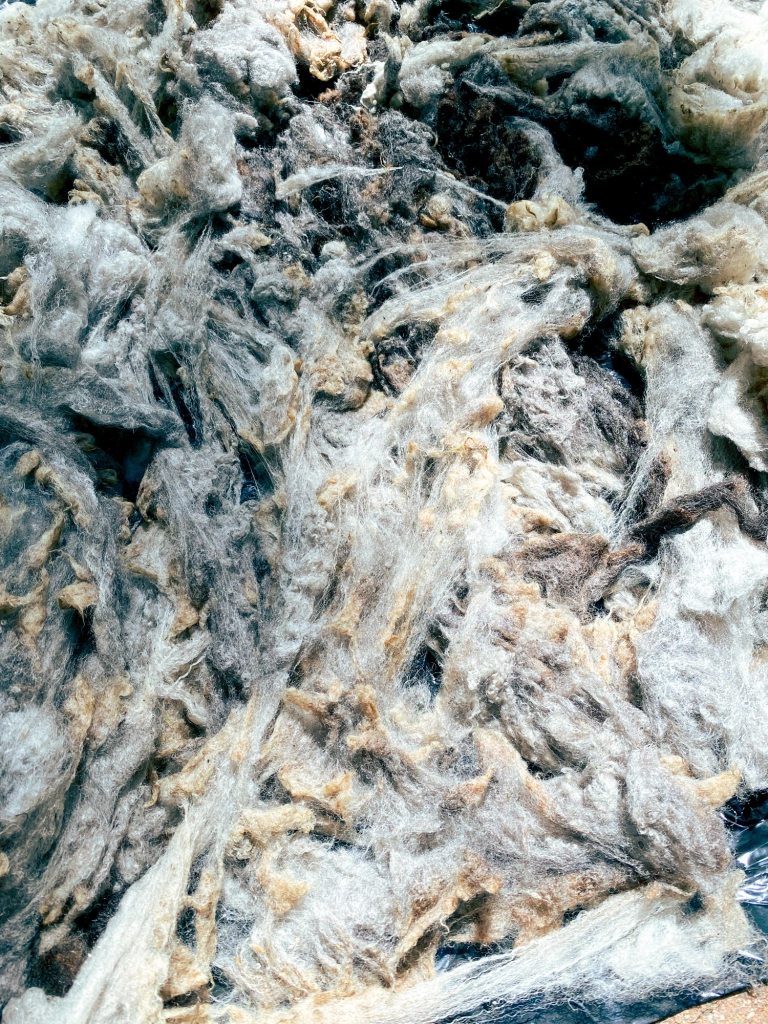
Homemade batt
I love photography, I love wool, I love flowers, and I love textiles. Oh and I also love sewing lingerie. As I’ve been thinking about these things, I’ve been thinking about how to create a life where they are all integrated.
I would love more than anything to run a small flower and sheep farm with a mini mill and be able to spend a lot of my time tending to the farm, photographing it, and making roving. It would be amazing to be able to put out prints or books of my flower photography.
I’ve decided that is what I want my life to look like in five years.
I’ve started taking some steps. I recently switched jobs and am now working fully remote. It has been amazing to be able to take the time I would have been commuting and be home to work on different crafts. It also enables me to move further outside of the city, which I hope to do in the next year.
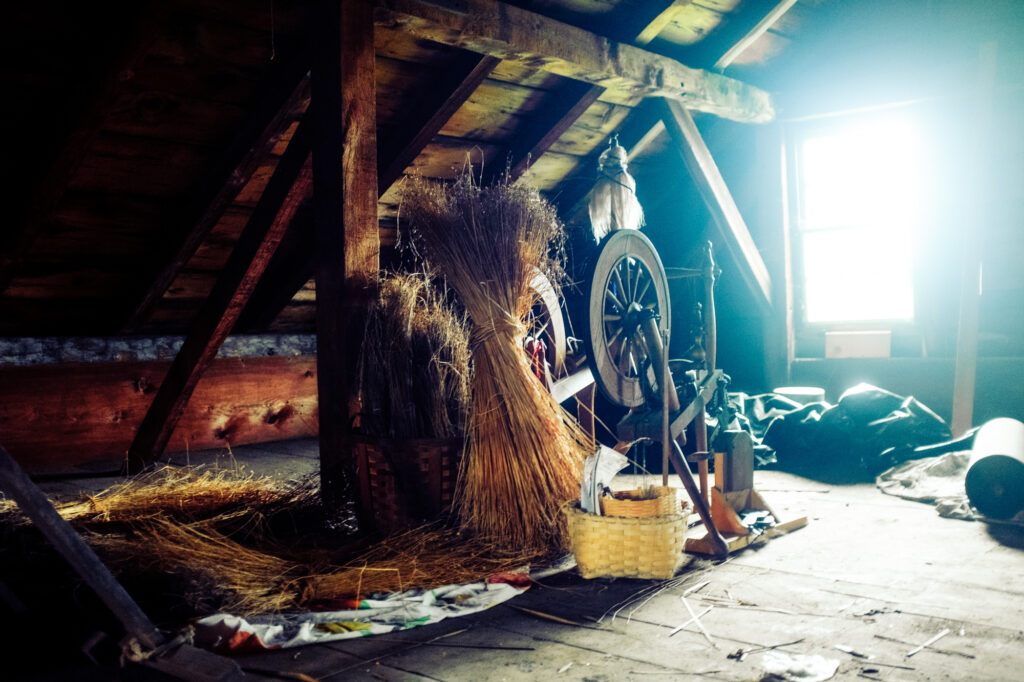
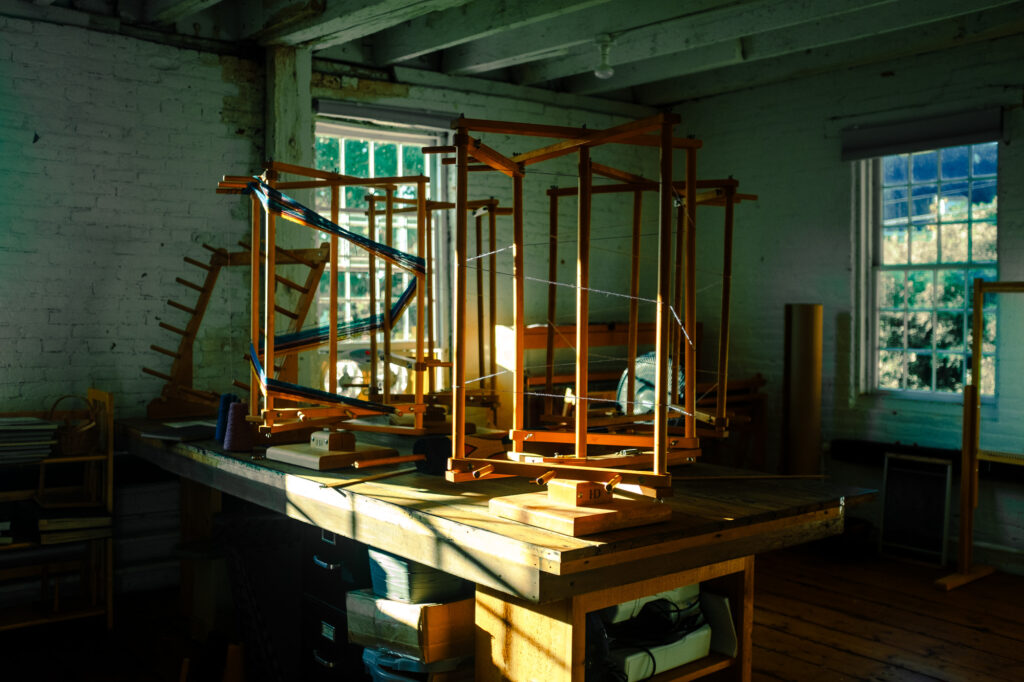
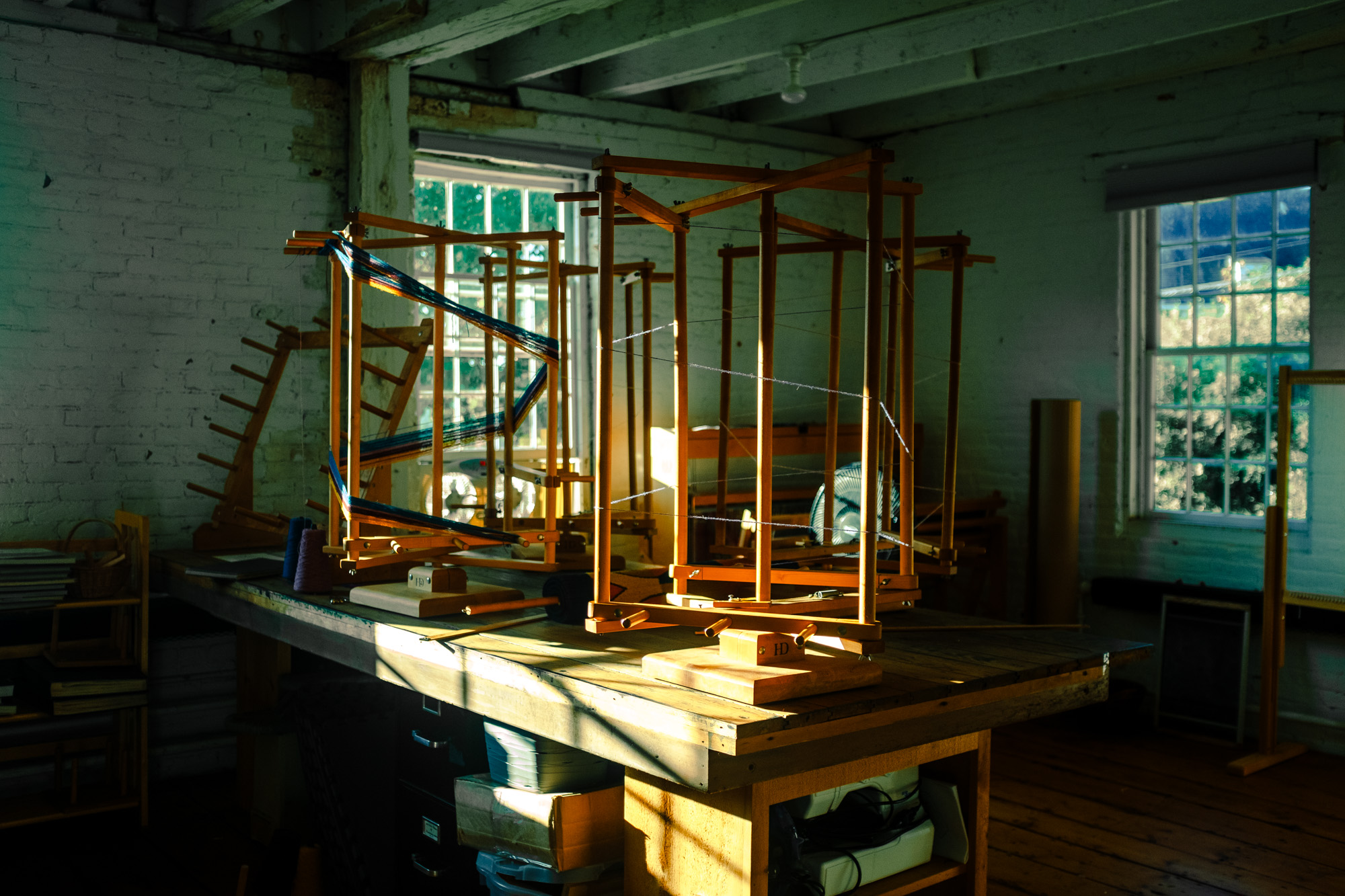
Attic in the shaker village that I think about often
I plan to continue using this blog as a place to document getting there. As I have more time and energy, I hope to make more and eventually sell batts. I’d also love to add to and promote my photography shop. Basically, working to lay down the foundation for where I hope to be in the near future.
And I hope that you all will stick around and see what happens. I know that it won’t come to fruition without people being interested in, sharing, and encouraging what I’m doing, so thank you all in advance, and let’s see what happens.
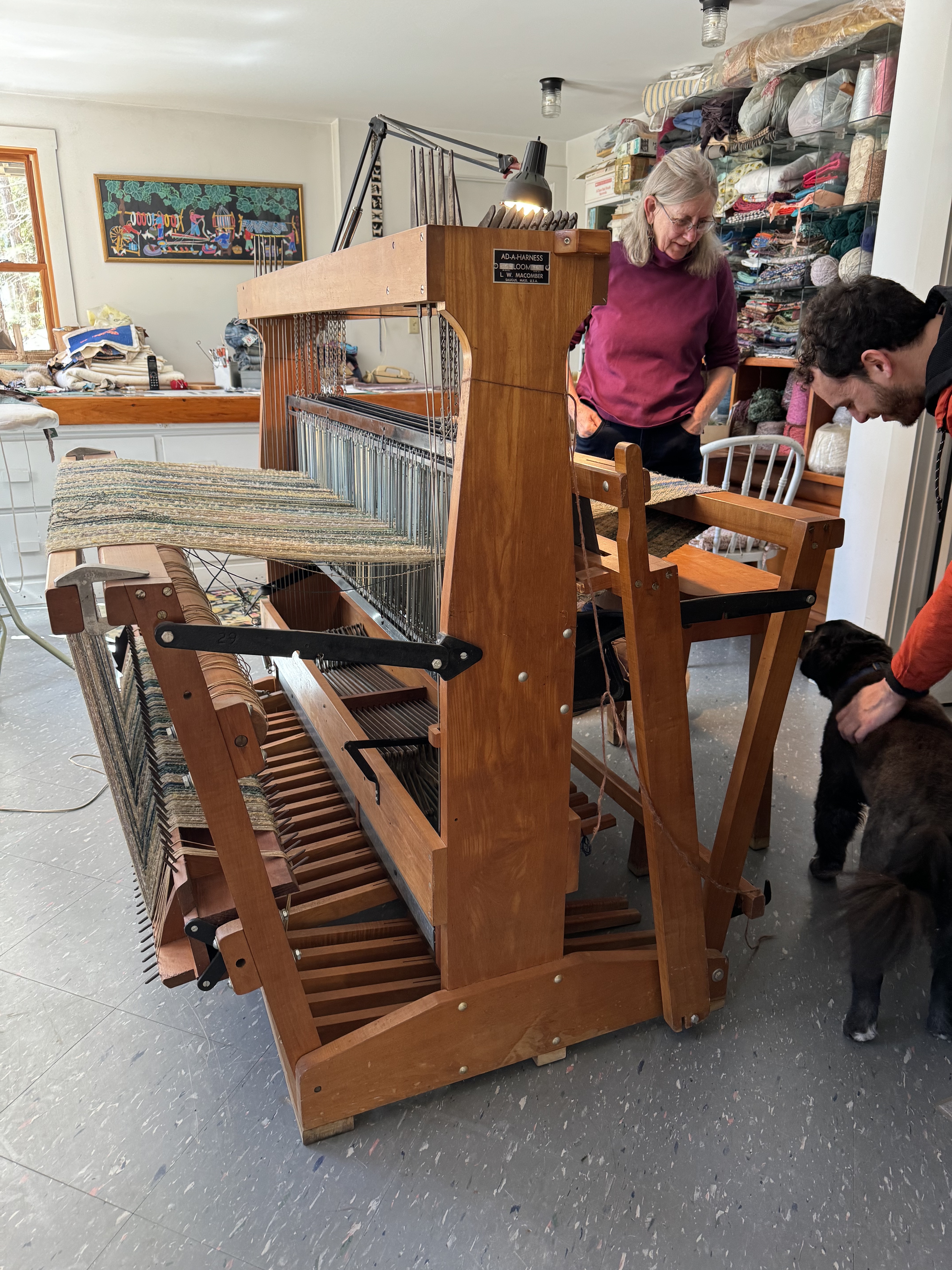
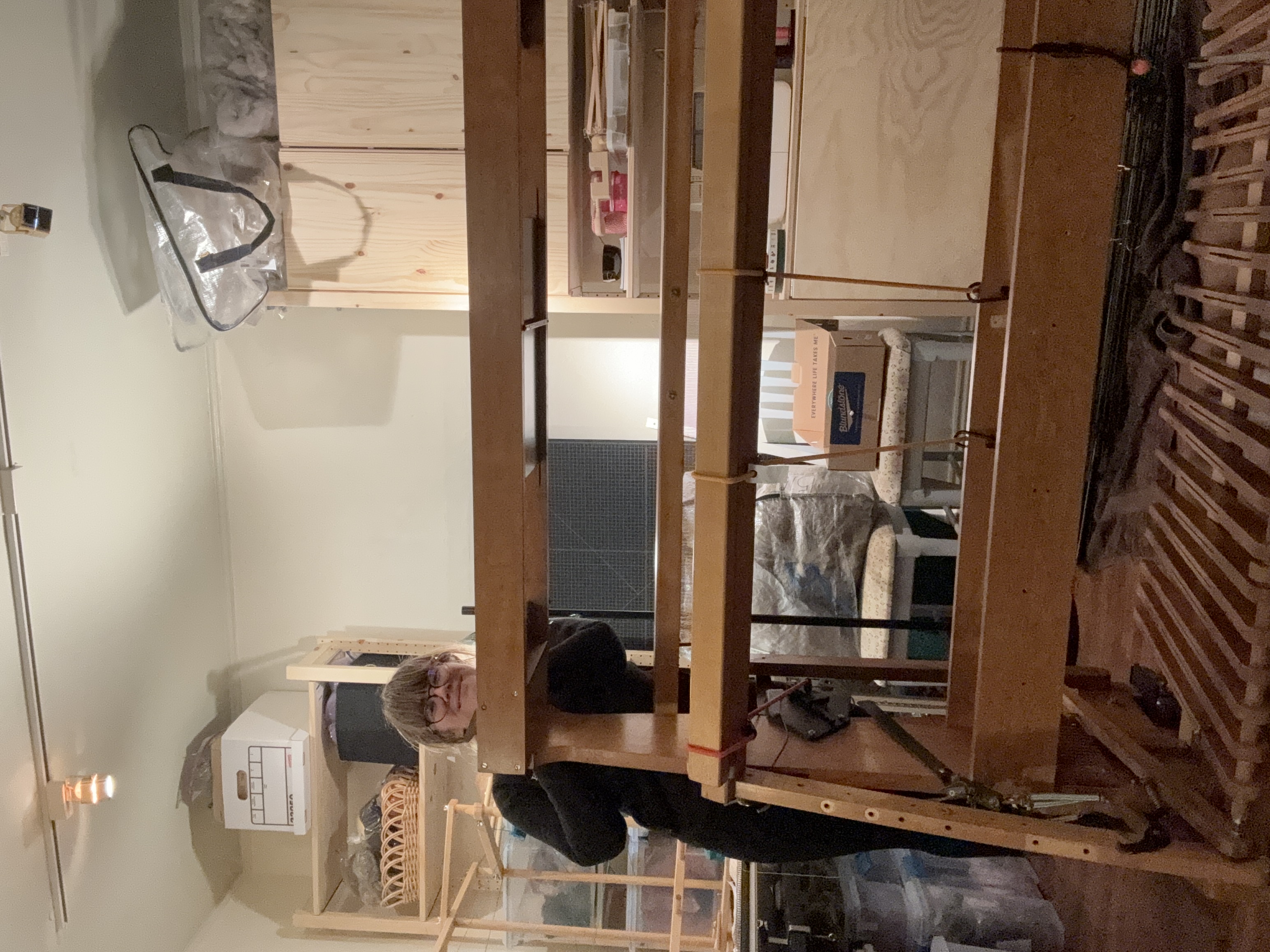
Last month I was able to purchase a 16 shaft, 48″ Macomber loom second hand. This is my dream loom – I had been looking at the cost of a new one, and knew I wanted to save up for that one day when I had the appropriate space for it. But, that plan quickly changed when I found a used one for sale while looking through the Boston Weaver’s Guild Used Equipment list.
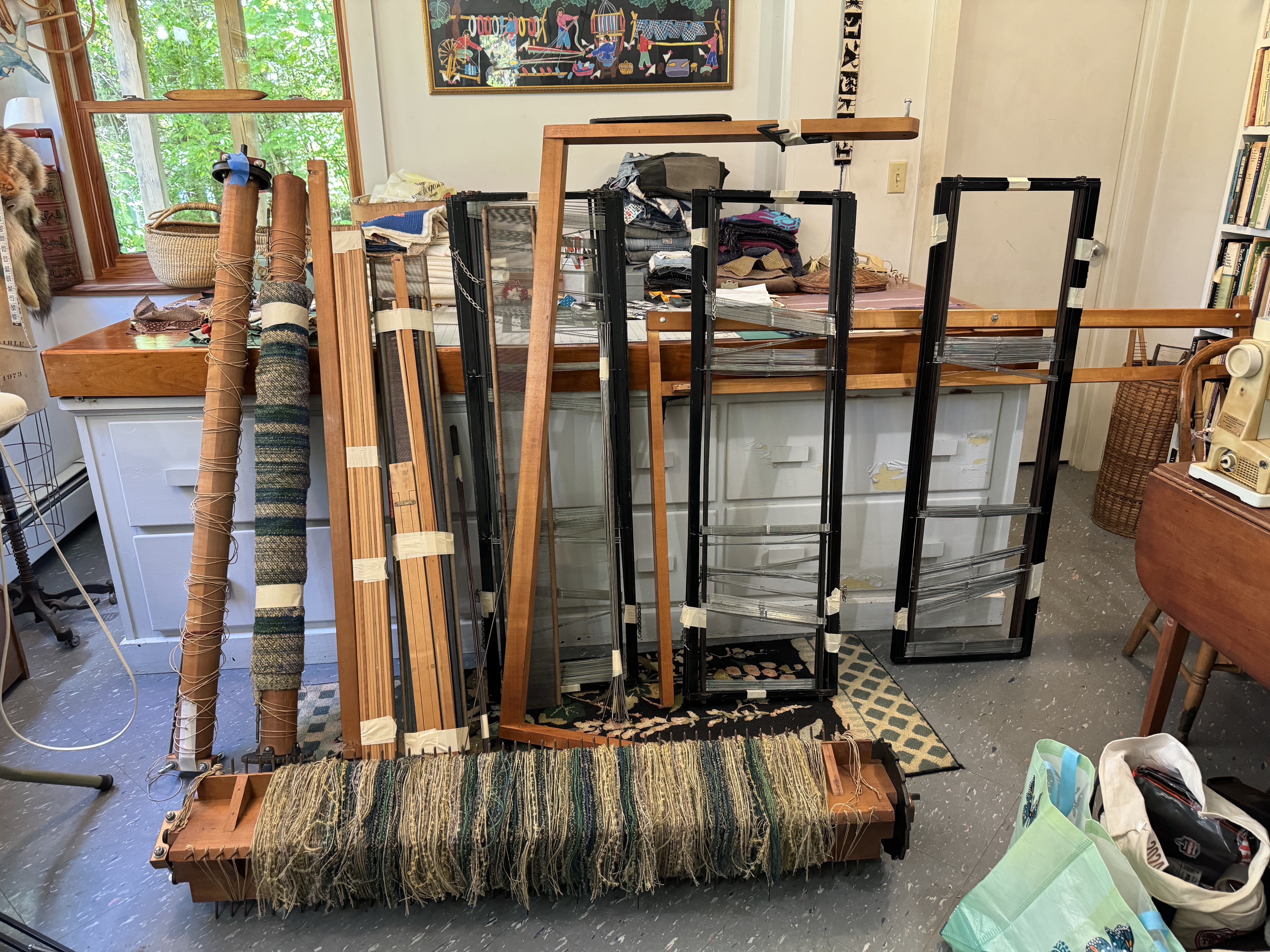
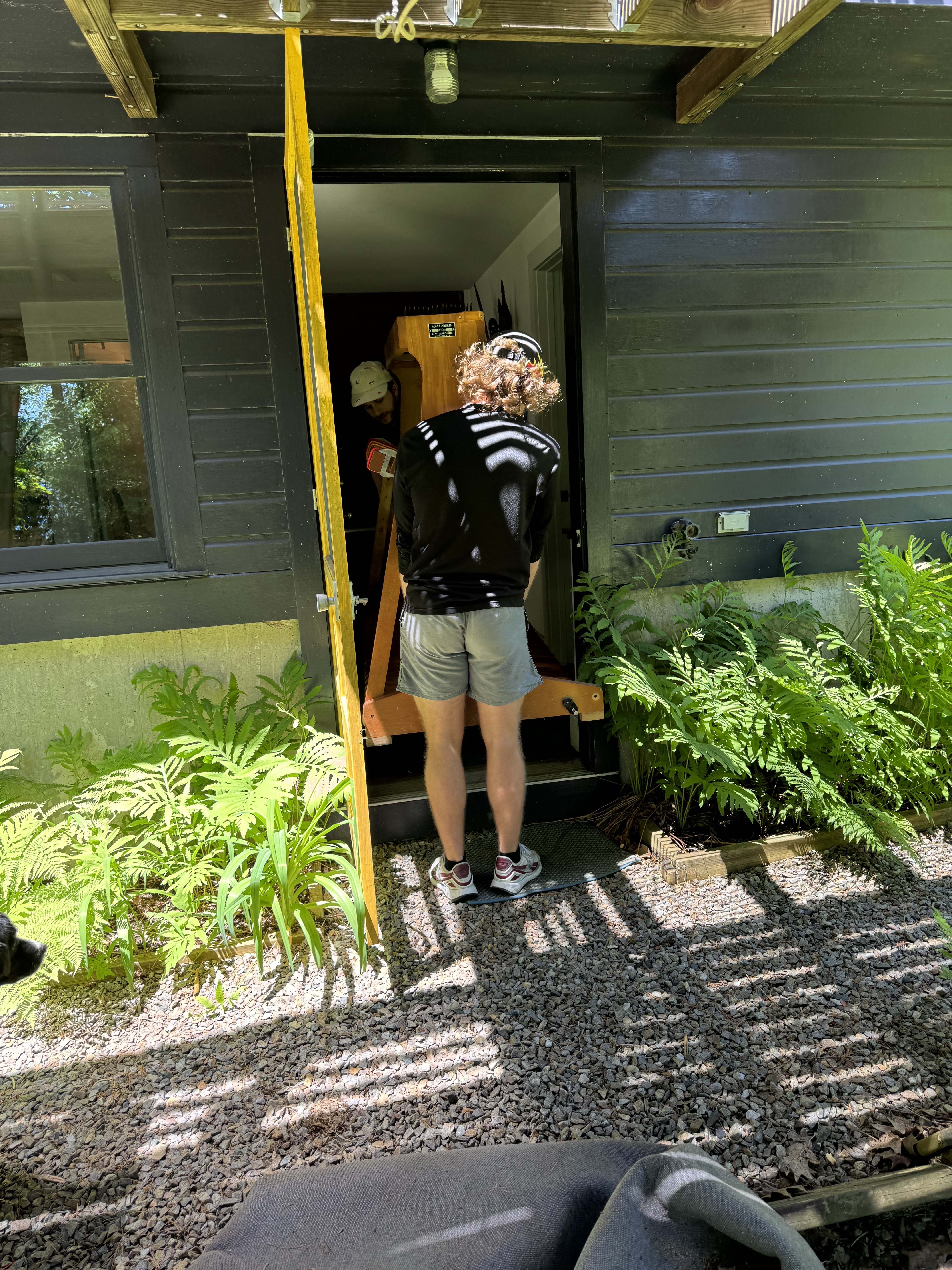
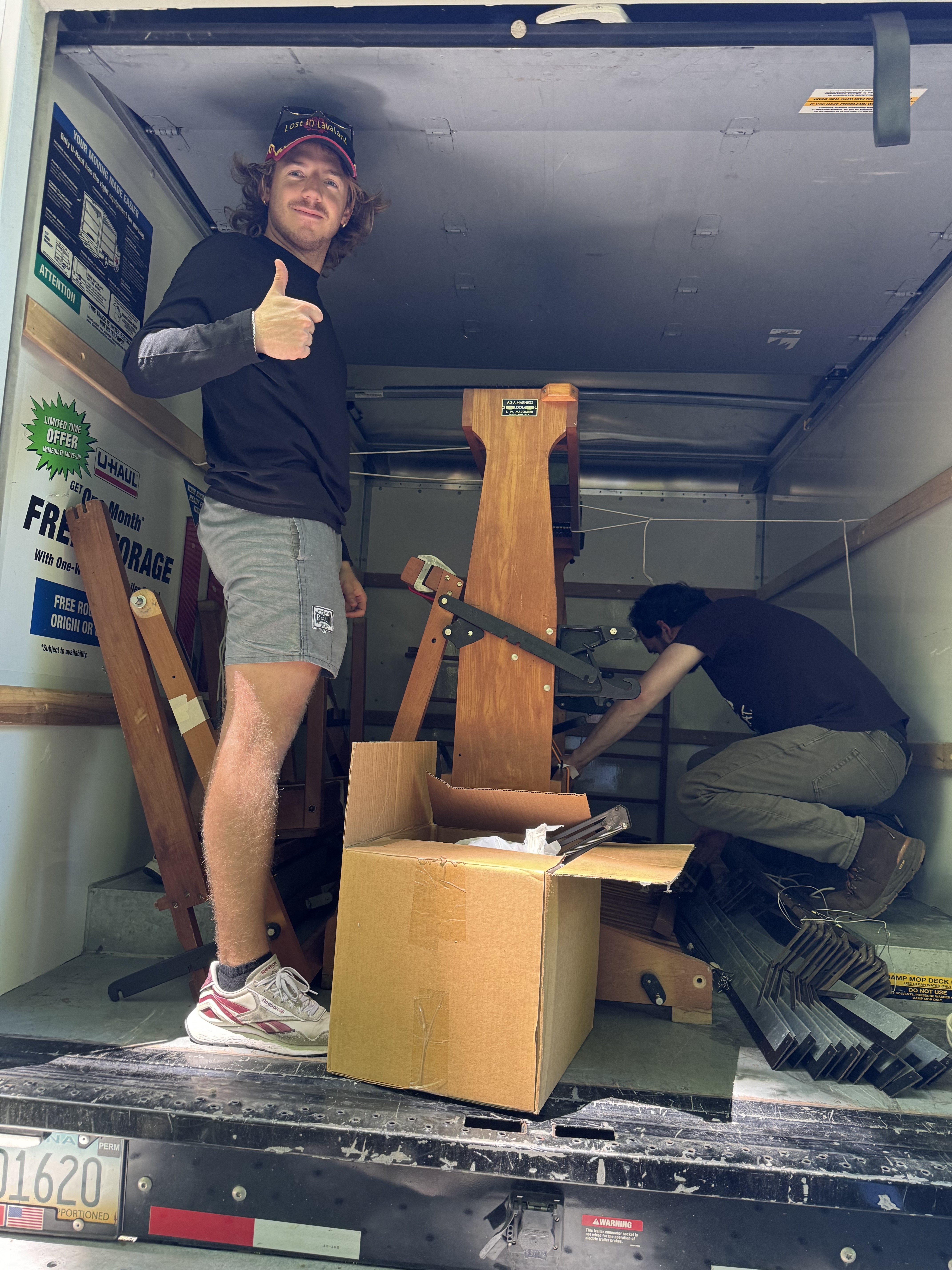
This loom was originally purchased in the 1970’s by a weaver in Harrisville, NH. She has had many different careers, and had sat on selling this loom for about a year. It is in decent condition – the wood is solid, all the pieces were there, and these things are built like tanks. It took about 3 1/2 hours to disassemble it enough to move it from the previous owner’s basement, into the U-Haul, and then up three flights of stairs into my Cambridge apartment.
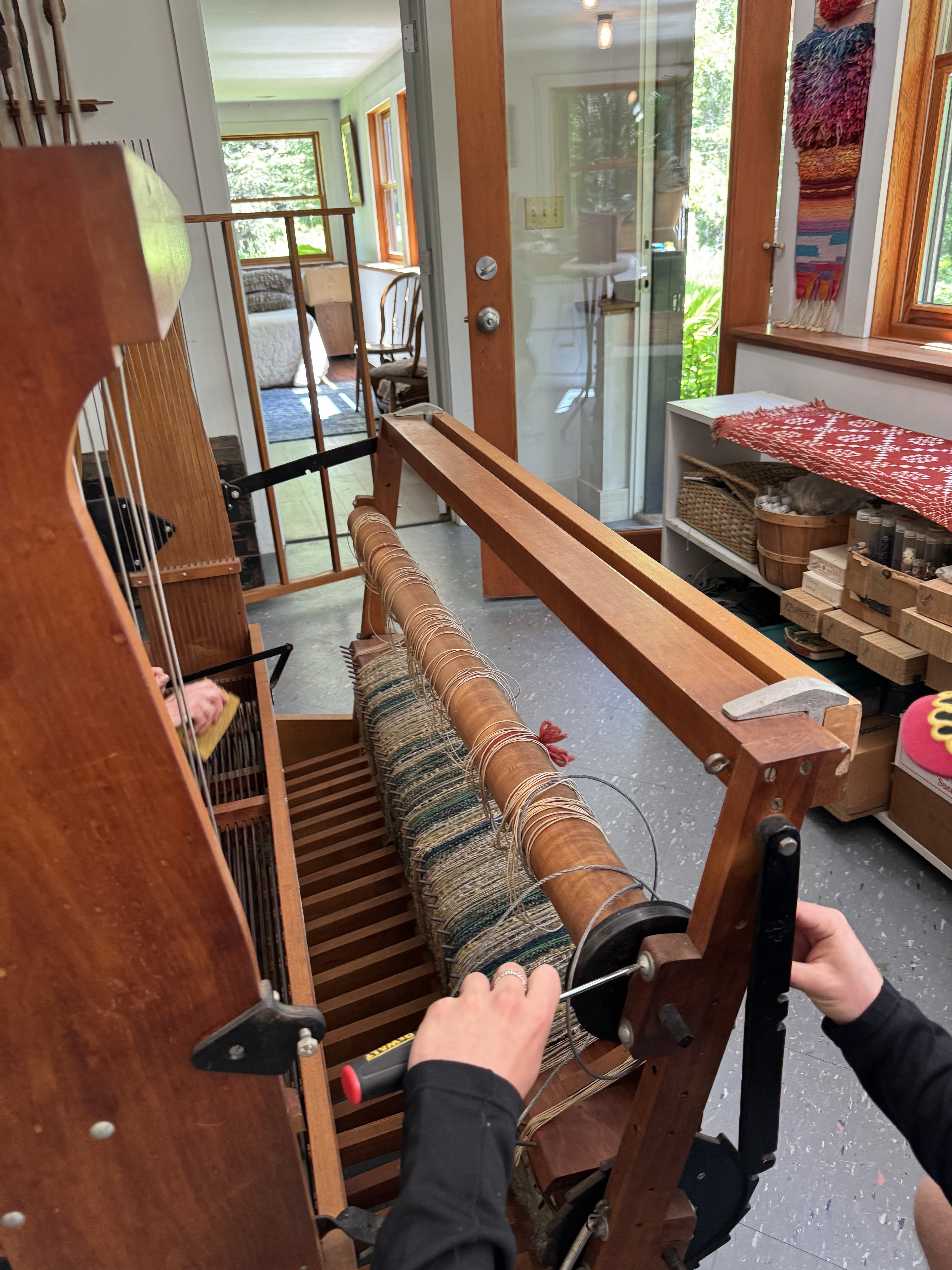
The loom also needs some work – it is dusty, there are tiny traces of mold on the treadles, and the rubber all needs to be replaced. Yesterday Jeremy helped me get started on the clean up. We removed the old rubber and, based on some recommendations for dealing with the small bits of mold, we wiped it down with warm sudsy water and sprayed it with a 1:1 vinegar and water solution. Now that the vinegar is dry, I’ll wipe the whole thing down with Murphy’s Oil Soap. The mold seems to be pretty surface level and I think the vinegar will do its job in killing it, and the oil will help seal it, but the stains will still be there. I think to fully remove the mold, I would have to sand and re-stain, which isn’t really feasible in my apartment. Hopefully that choice doesn’t come back to bite me, but I may do that when I eventually move and have to take it apart again.
The beams also need the apron strings replaced. The ones on there are dried out and seem like they could snap under tension. The kits are still made by Macomber and not too expensive.
My goal is to get it in working order by the end of the month, but it has been slow going so far. I want to make sure I take the time to do things right (within the constraints of my apartment) so that it can be my dream loom for pretty much the rest of my life.
I haven’t really sat down to write or document anything formally because in a lot of ways I haven’t “finished” anything.
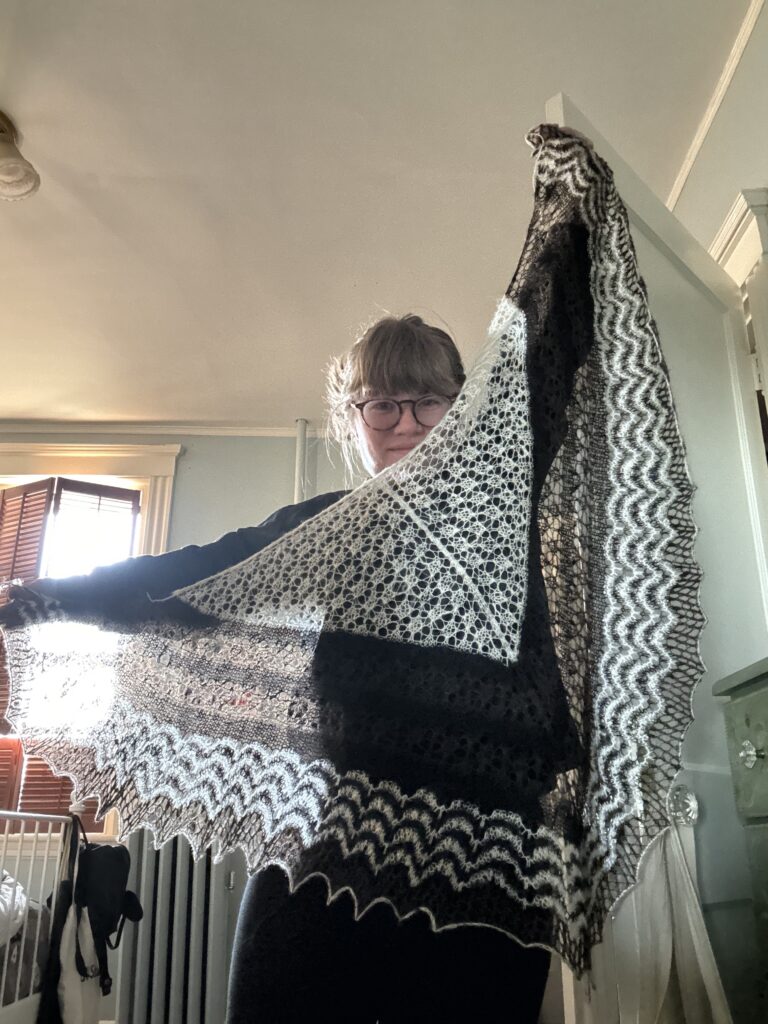
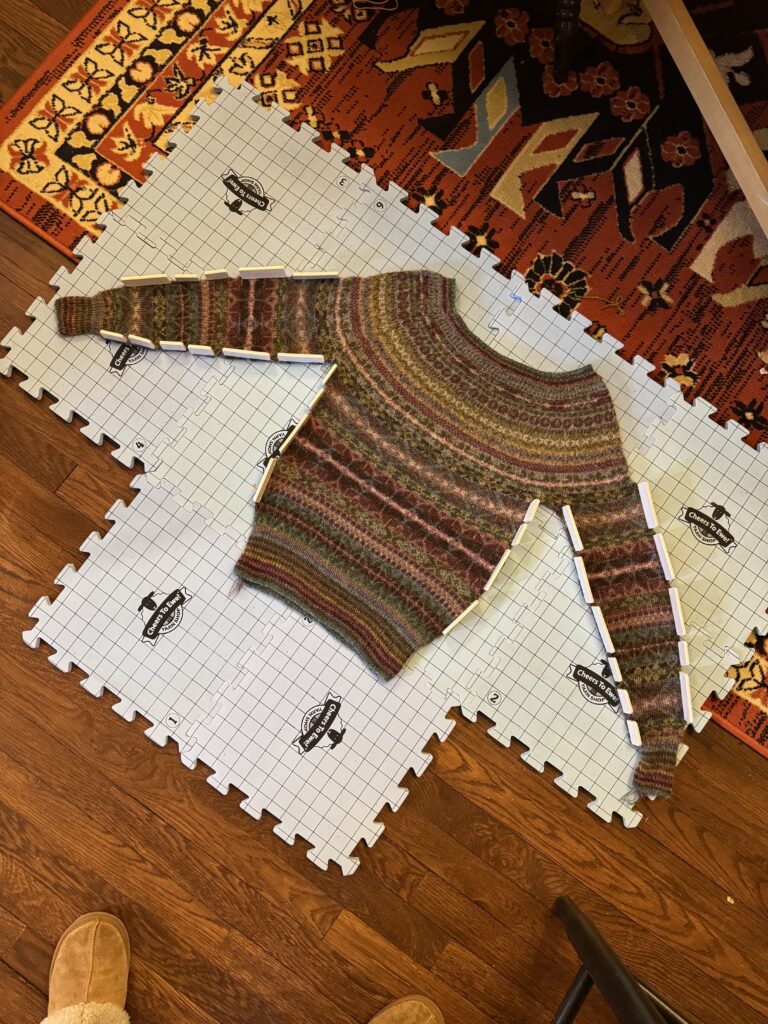
But in reality, that isn’t 100% accurate – I have finished the sample for my Önska pattern and writing the first draft of the pattern, I finished an entire handspun shawl, and I have finished a lot of handpsun yarn. I’ve also almost finished fixing my Primrose (the neck opening is still too wide).
I’ve also made a lot of progress on other pieces – I’ve outlined a handful of really solid sweater patterns I hope to sample knit, write-up, and release in the coming year; I’ve gotten Jeremy’s blanket onto the loom in order to attempt weaving a full-sized blanket – a long-term goal of mine; and I’m starting to understand what types of yarns I like to spin and am getting better at taking notes(!)
I’ve also purchased a pants sewing class from Sew Liberated, and I’ve reorganized my “studio” room to have a clear floor (just in time to look at purchasing a Macomber 16-shaft loom second hand, but let’s celebrate the small wins, ok??)
Anyway, that’s all for now. Hopefully there will be another finished sweater or two sometime soon…
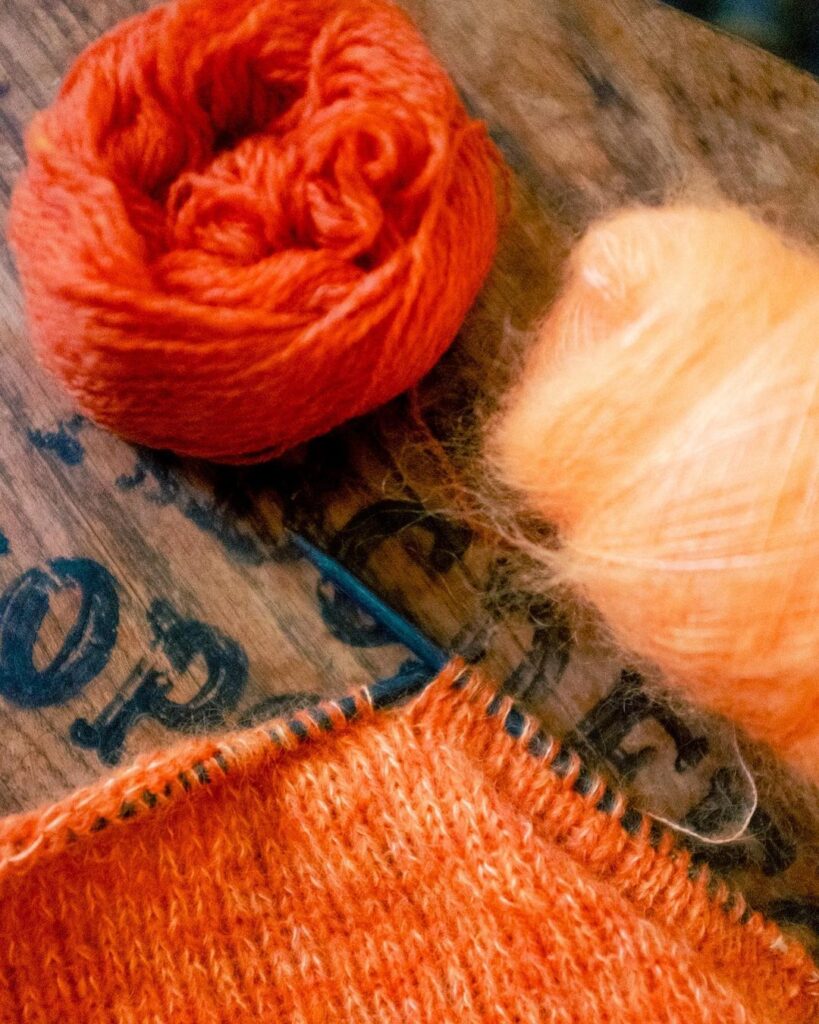
Honestly, this is really only a half stash down project since I bought the mohair in order to cast this one on…but it still counts.
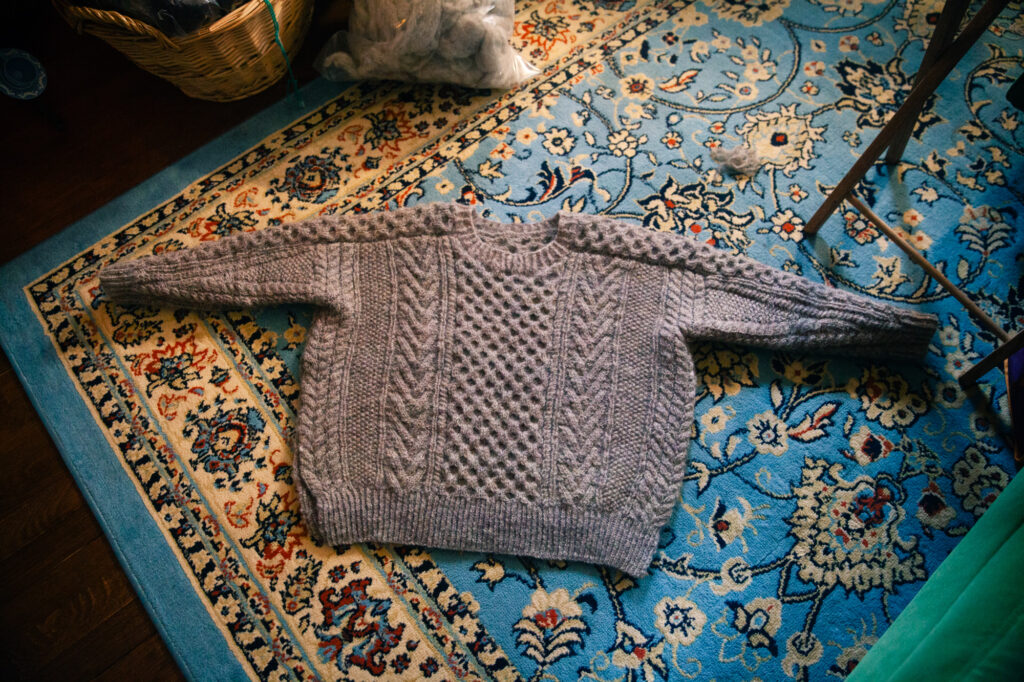
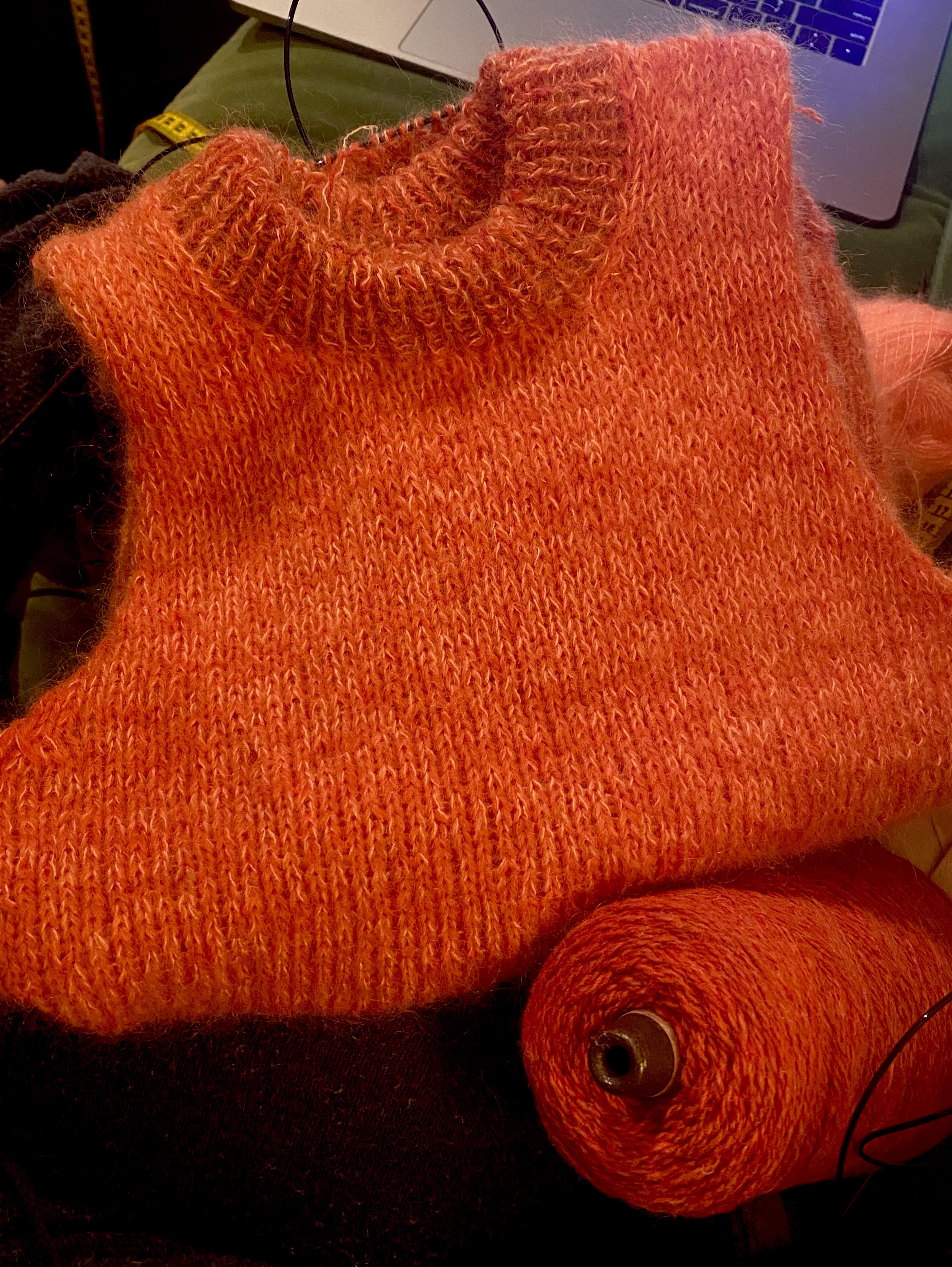
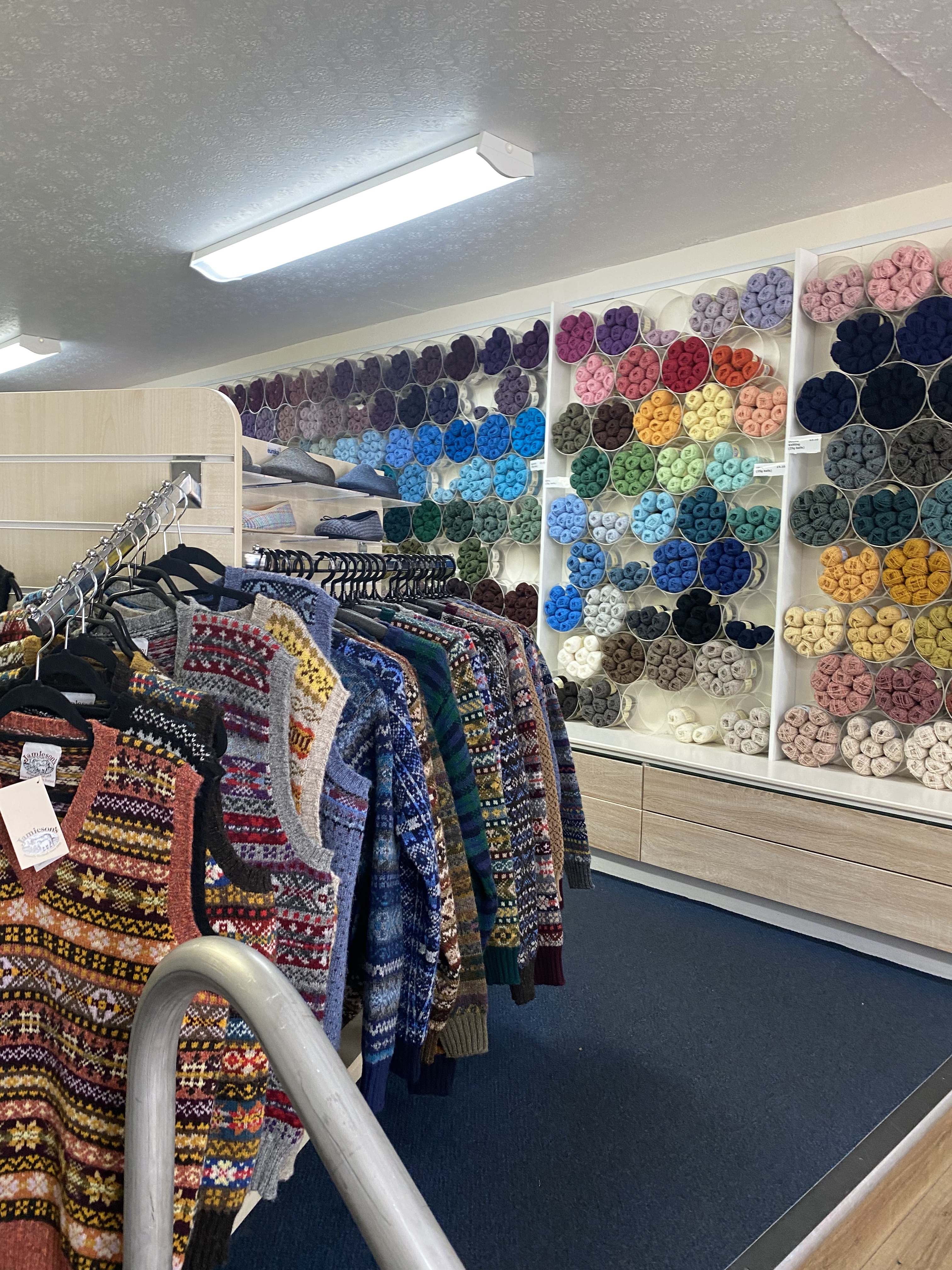
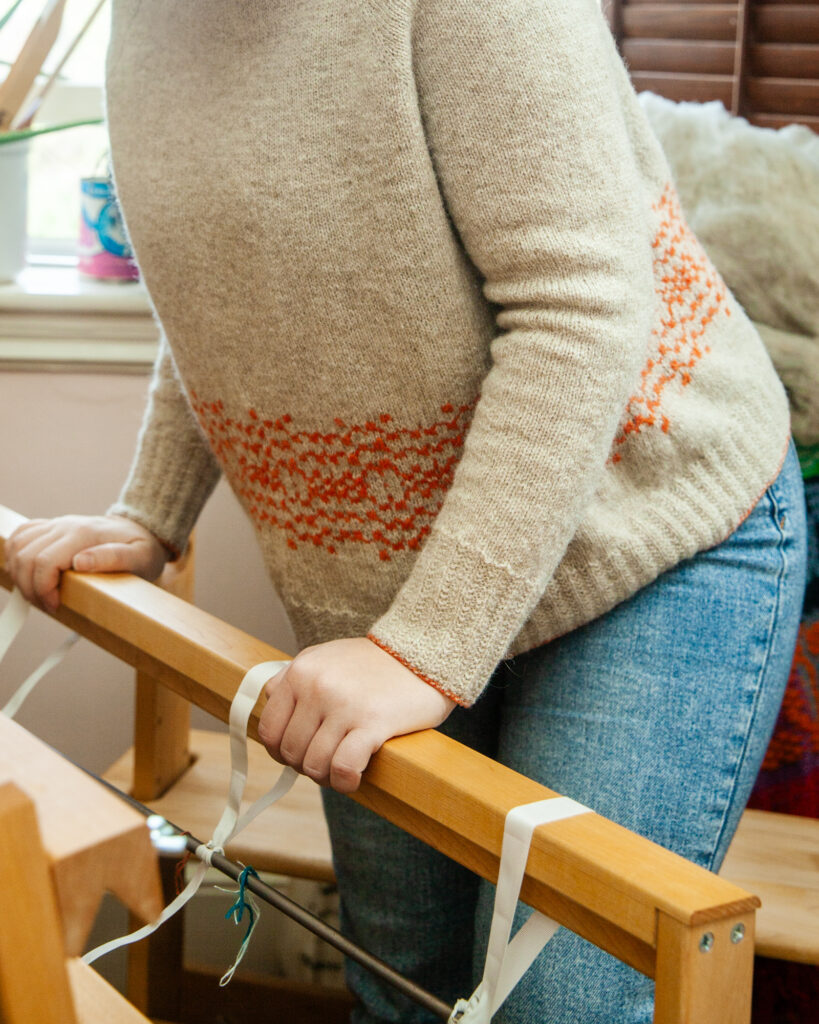
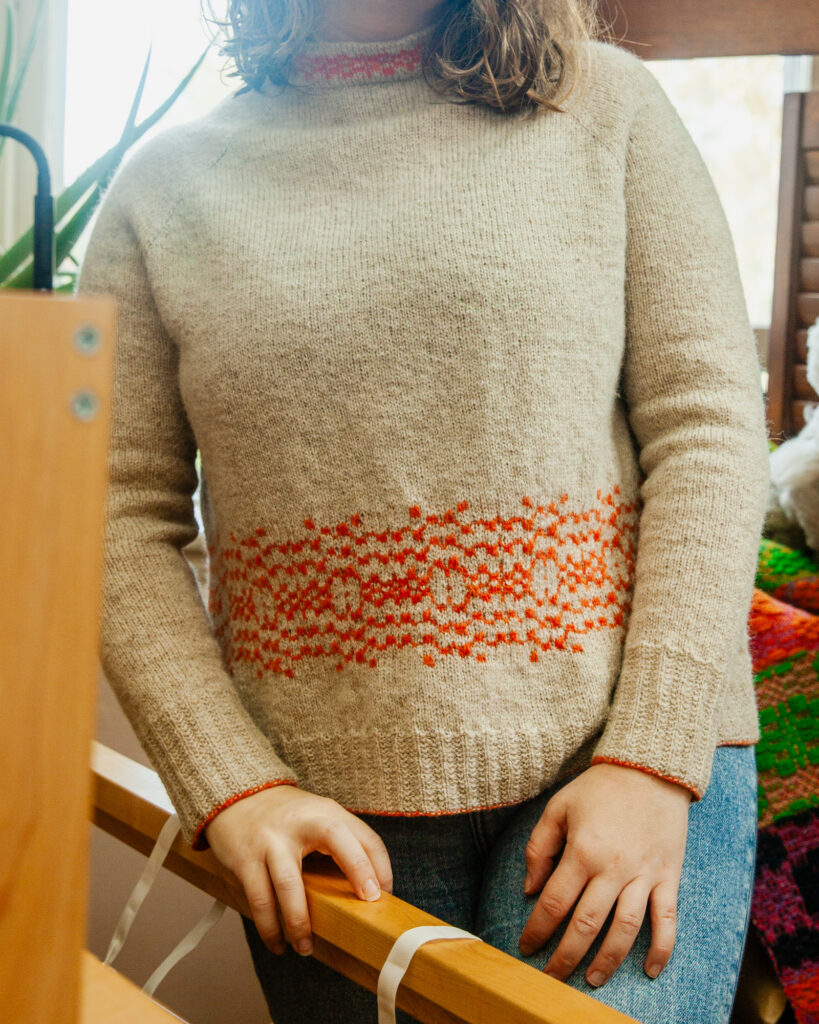
When I went to Scotland, I picked up two balls of J.C. Rennie’s Supersoft 4-ply in this beautiful pure orange. I knew the color was perfect for something, but it was early in my trip and I didn’t want to go overboard too quickly. As a result, I only picked up two balls. I used part of the first ball for my Autumn Overshot Sweater (pattern release coming soon!), but then I was thinking about Halloween and just wanting a bright orange sweater…
I knew that I had knit a Cozy Classic Raglan with only two skeins of hand-dyed mohair, and after looking at a few other projects on Ravelry, I concluded I could probably get a really small, cropped sweater out of the 1.9 balls of orange fingering weight I had left by pairing it with a mohair.
So then I had to pick out a mohair. I absolutely LOVE Full Moon Fibres, and I had always been interesting in using their Hi-Vis color for something Halloween-y. I ordered a few skeins of that and went to work figuring out what was the smallest sweater I could knit that I could also still fit into.
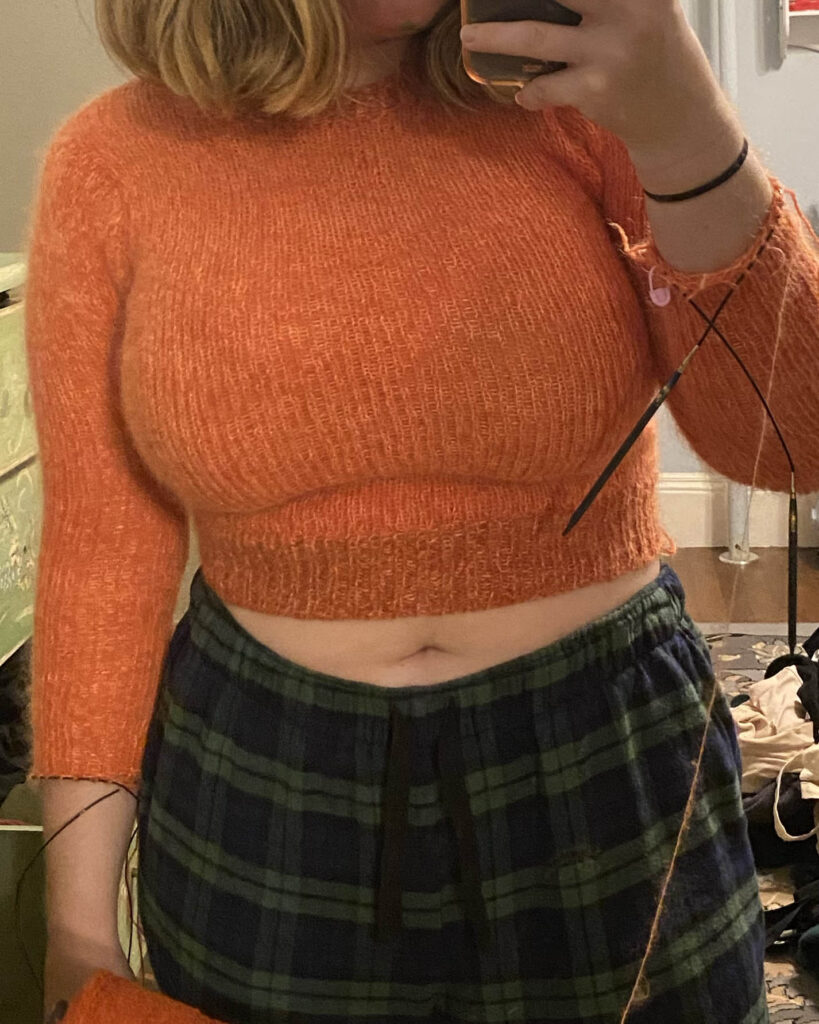
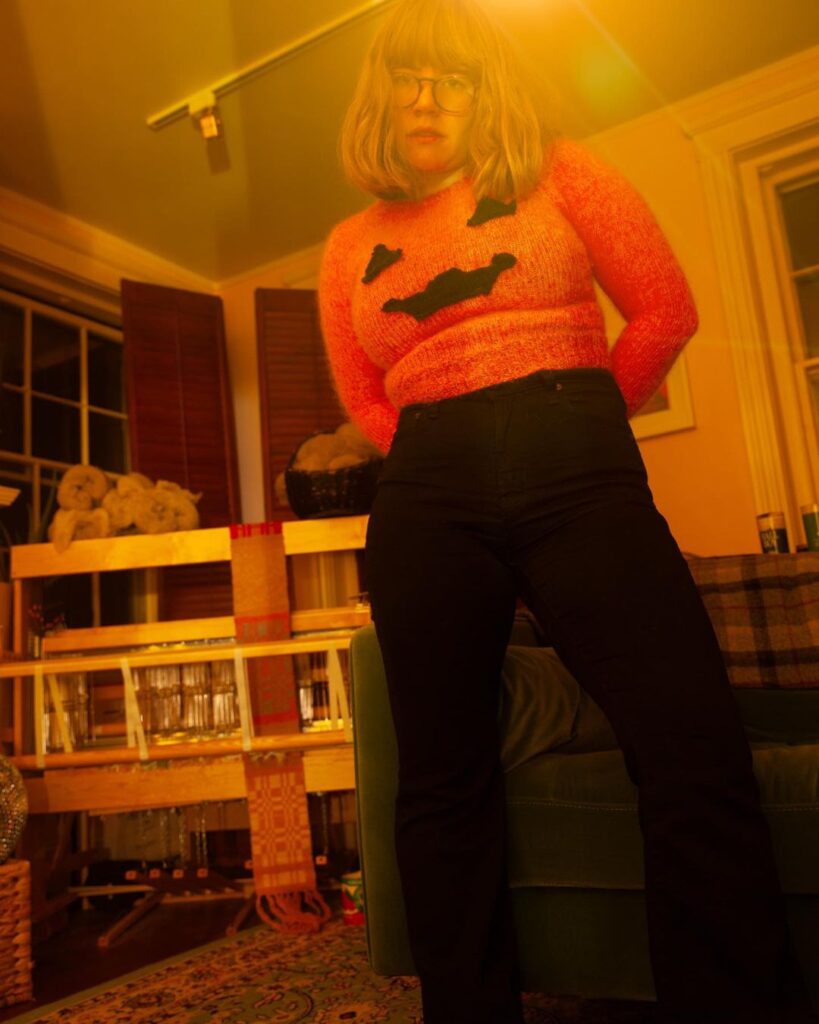
The sleeves took a few tries, but in the end I wound up with a cropped set in sleeve sweater that I’m pretty happy with. It looks cut with high waisted jeans, and I made a removable Jack-o’-lantern face out of some Harrisville Designs Highland in black for actual Halloween.
Next up on my stash down projects, I have a few options. I have a Primrose sweater that is technically finished, but doesn’t fit, and requires ripping out at least the yoke and possibly the sleeves in order to fix it.
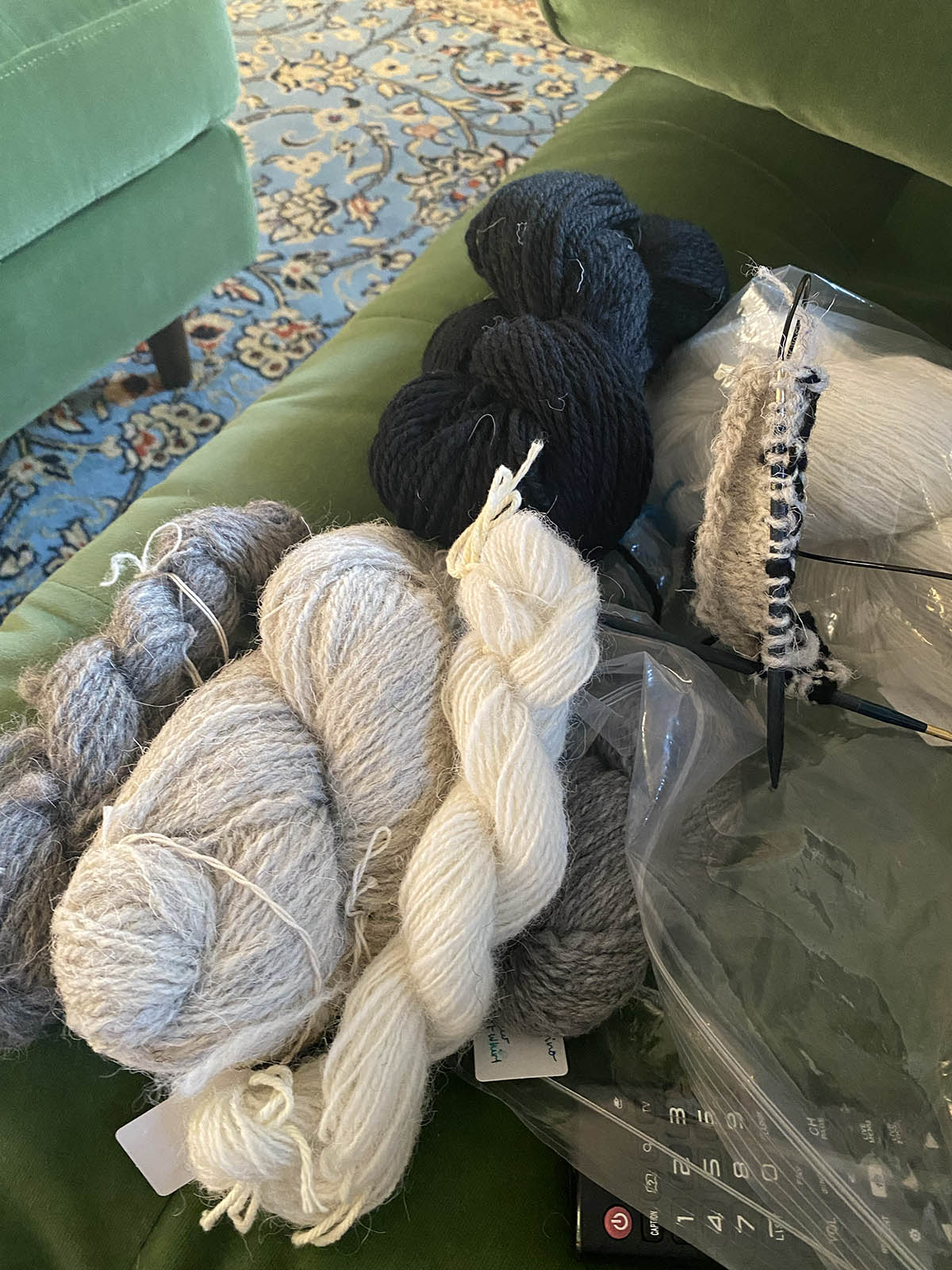
I also have a Lunenberg with Alice Starmore leftovers and some Harrisville Designs Shetland still lingering, and a plain fitted black Plötulopi sweater that I’d like to get wrapped up.
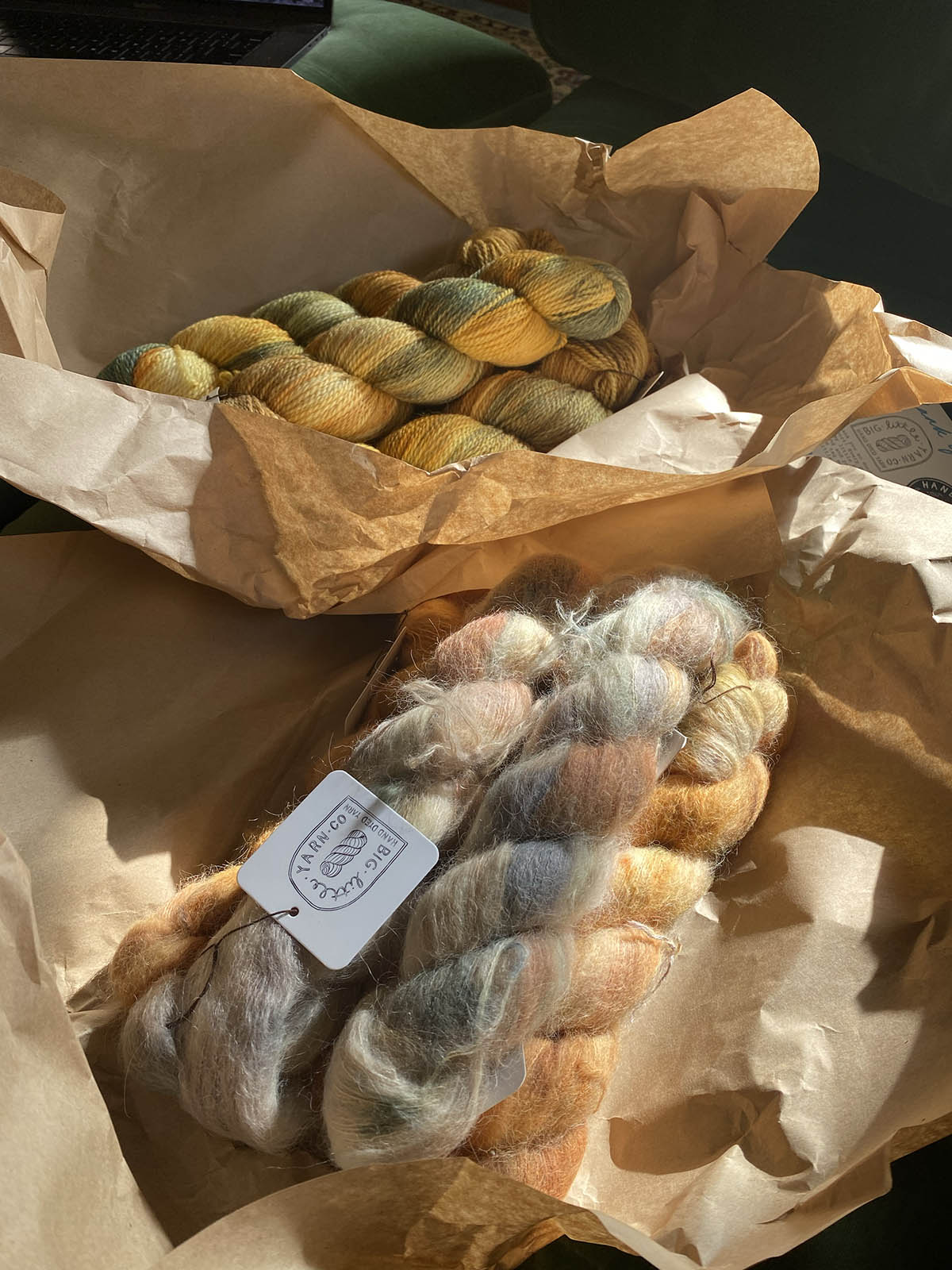
After that, I’m hoping to start a project with some of my Big Little Yarn Co. stash – the colors are beautiful, and I’ve never really knit with an indie-dyed variegated yarn that wasn’t mohair/suri before, so I’m excited to see what I might be able to do with that.
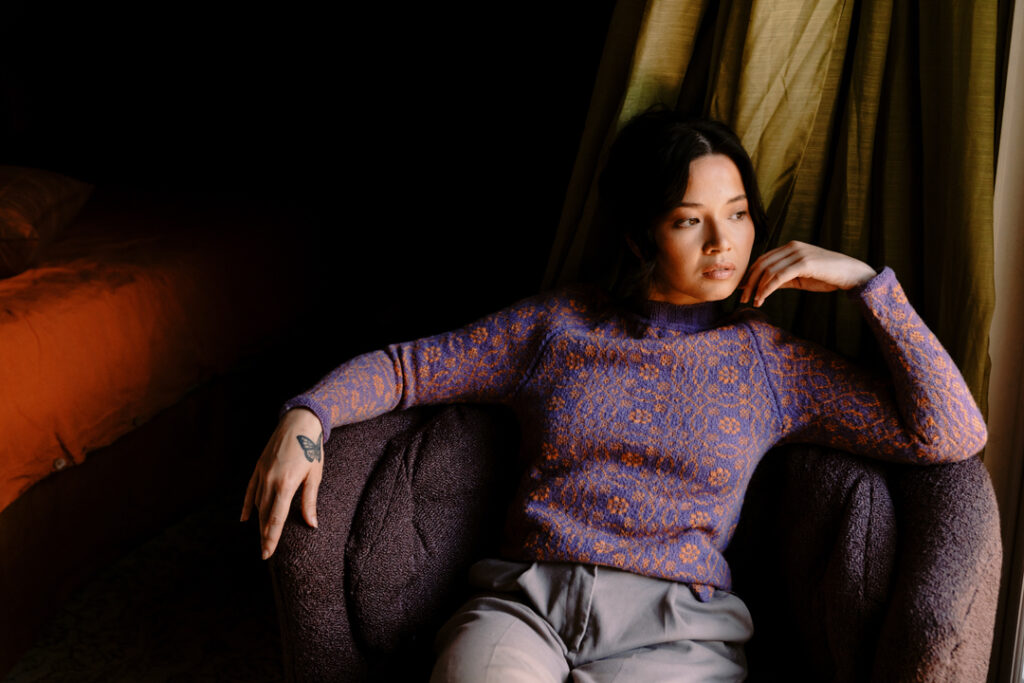
I’m so excited to finally be able to share that I am a contributor to the next and final issue of Pom Pom Magazine! The issue contains an amazing array of knitting patterns, including an insanely cool leisure set I will definitely be knitting by Elspeth Vance, all inspired by woven fabrics.
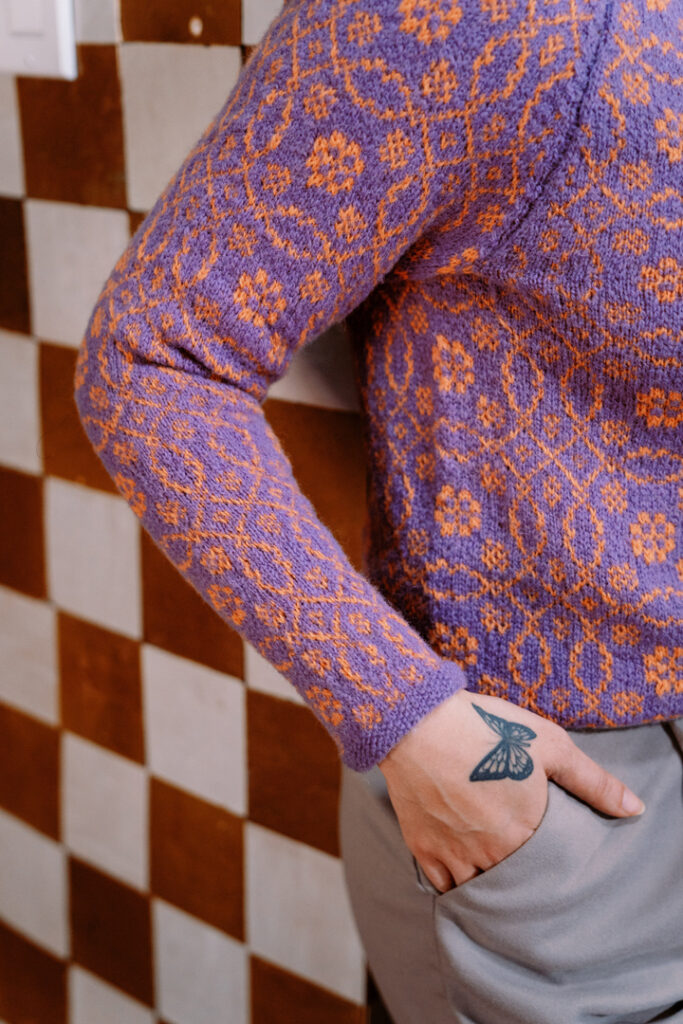
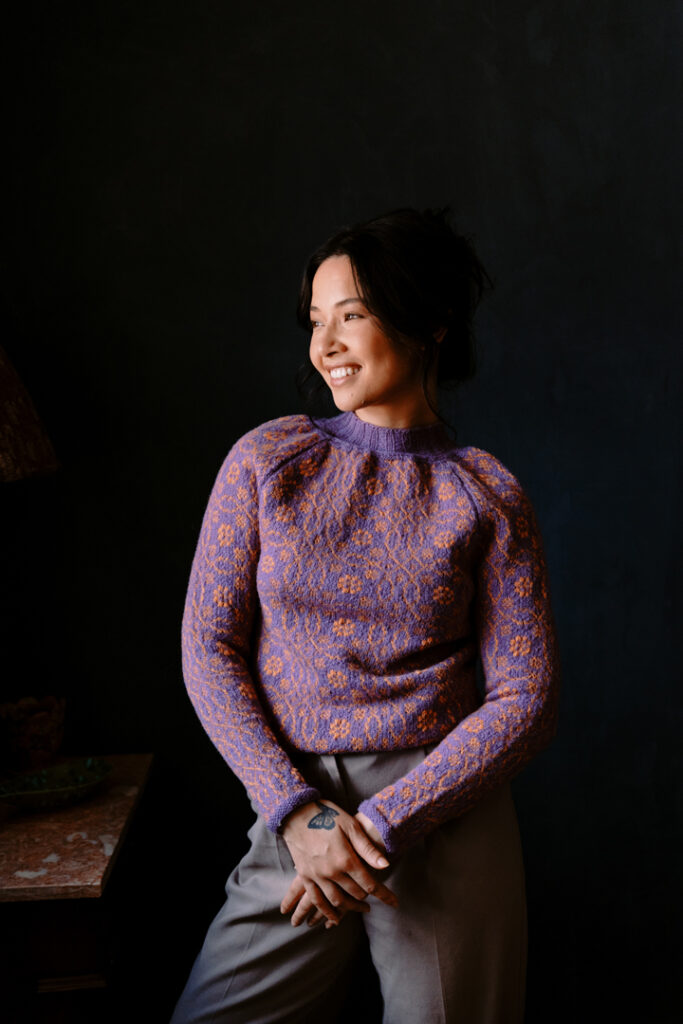
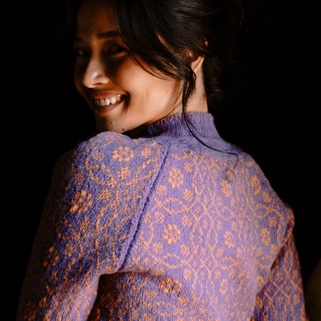
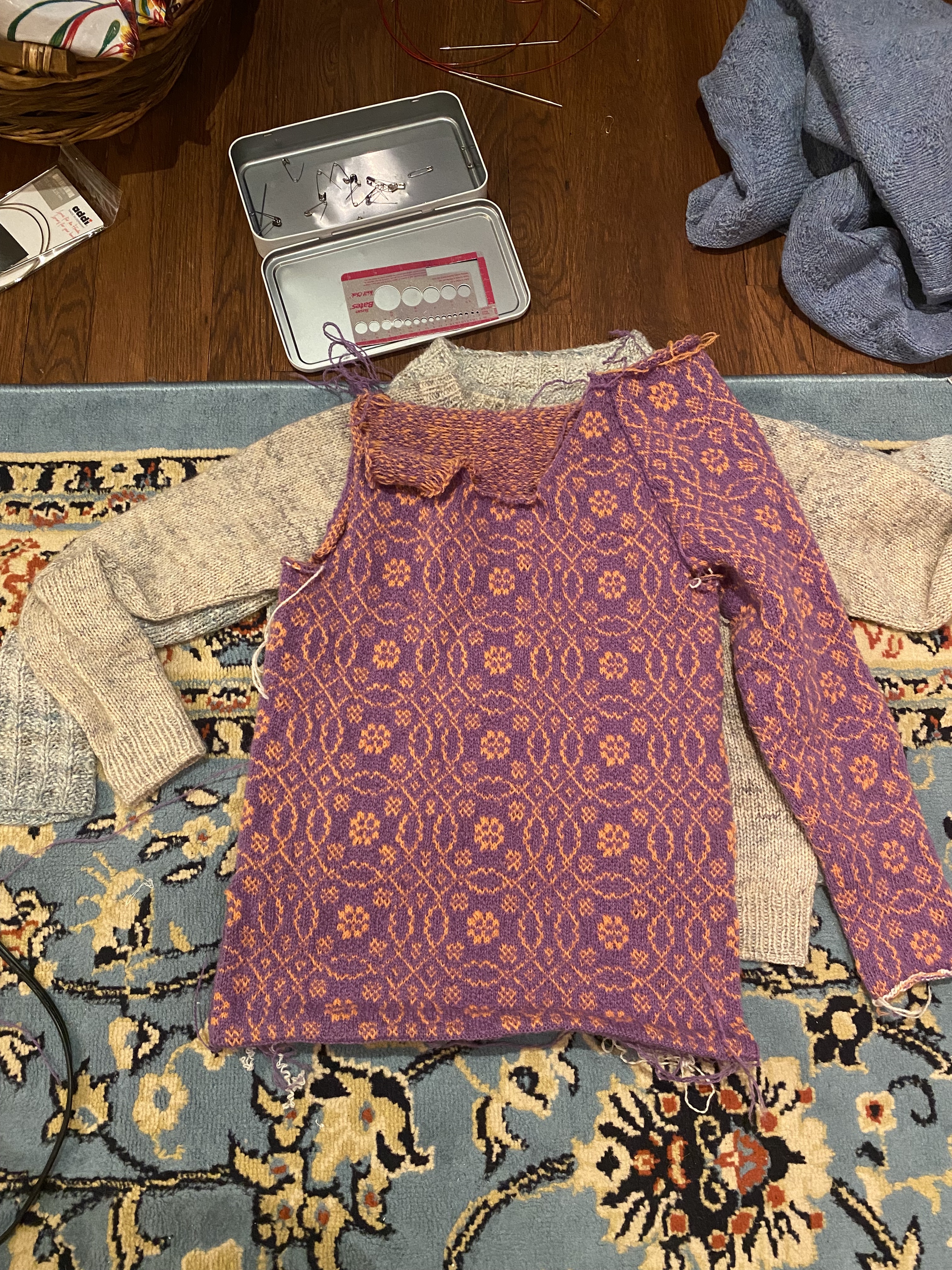
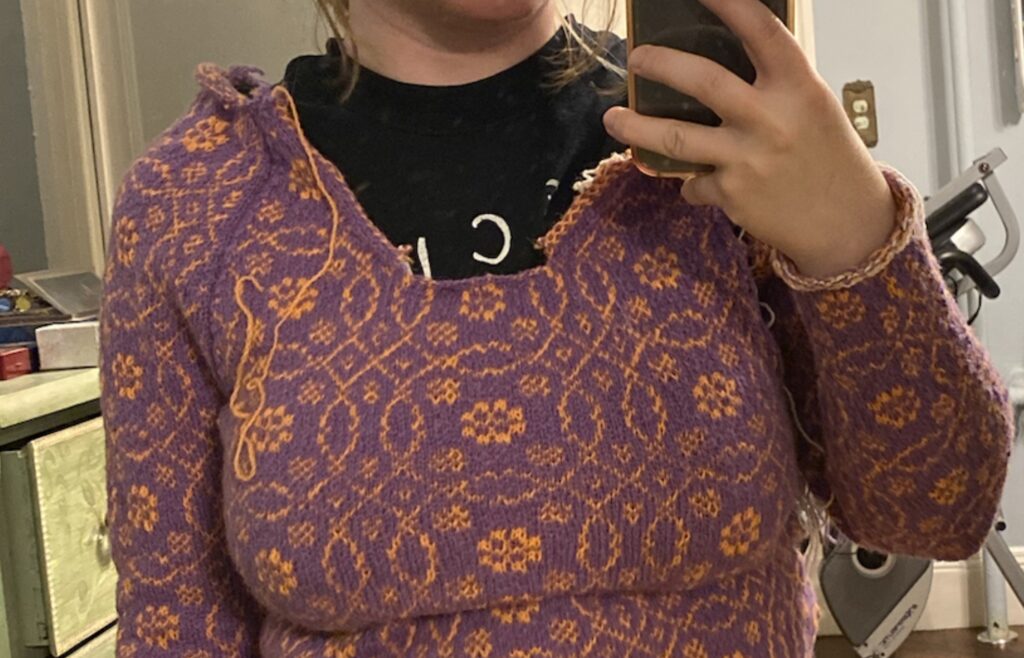
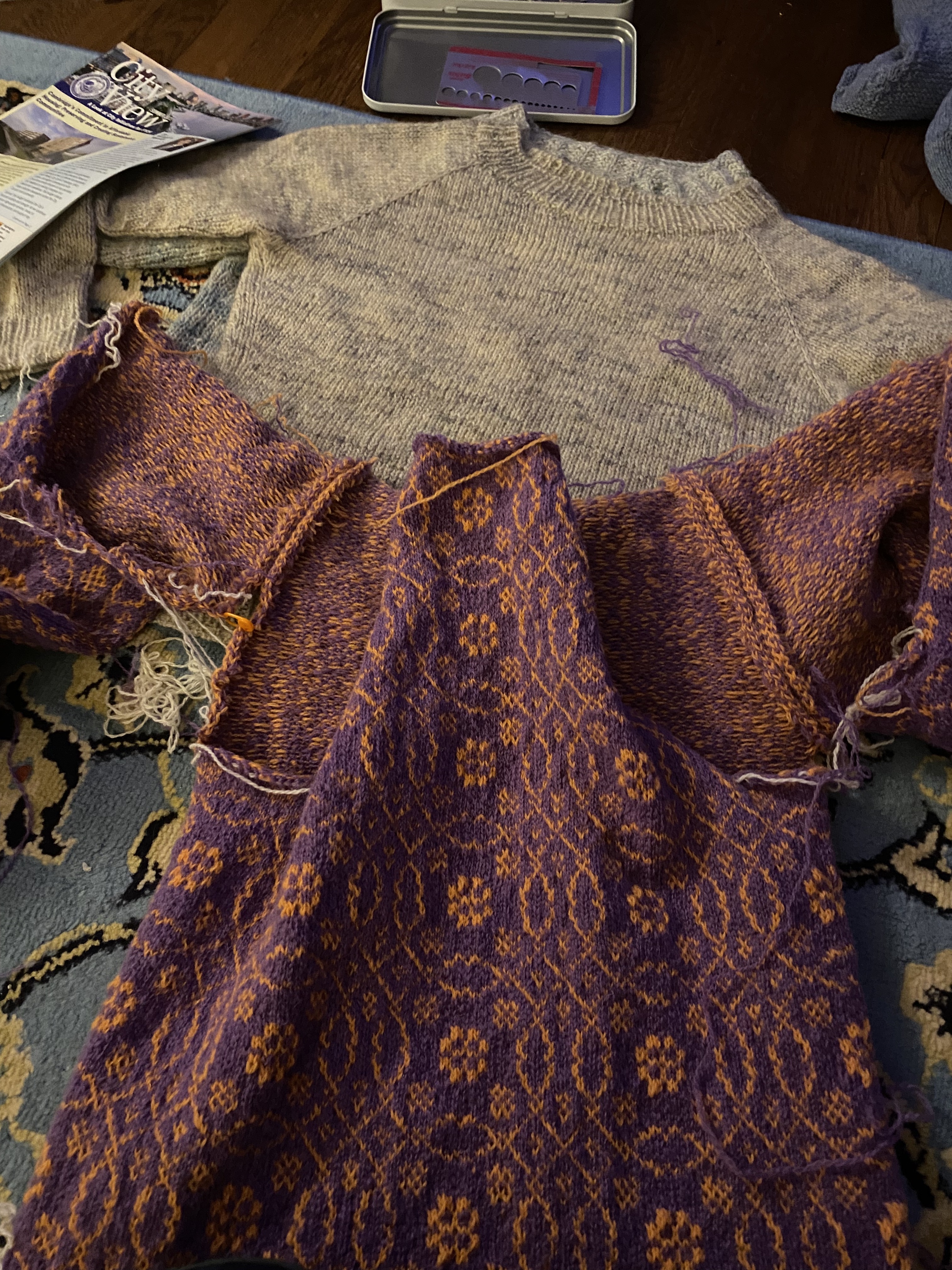
My contribution to this issue is Coverlet – a colorwork raglan sweater inspired by the traditional whig rose weaving pattern. It is knit bottom up in the round, with steeks for the neck and armholes. You knit the sleeves bottom up with steeks for the shaping, cut all the steeks open, and seam the pieces together. You end with picking up stitches for the neck, adding some short rows in a textured pattern, before finishing it off with a 2×2 rib mock neck.
My office asked me to talk a little bit about the process of designing this sweater, and I thought I’d also write that presentation up here.
It started when Pom Pom put out a call for submissions back in February for the theme “woven.” I’d been stewing on some ideas of knitting patterns inspired by woven motifs for a while, and figured this would be a great way to try out designing (if I got accepted). I also was excited that you only had to submit your idea – you didn’t have to write up a pattern to submit.
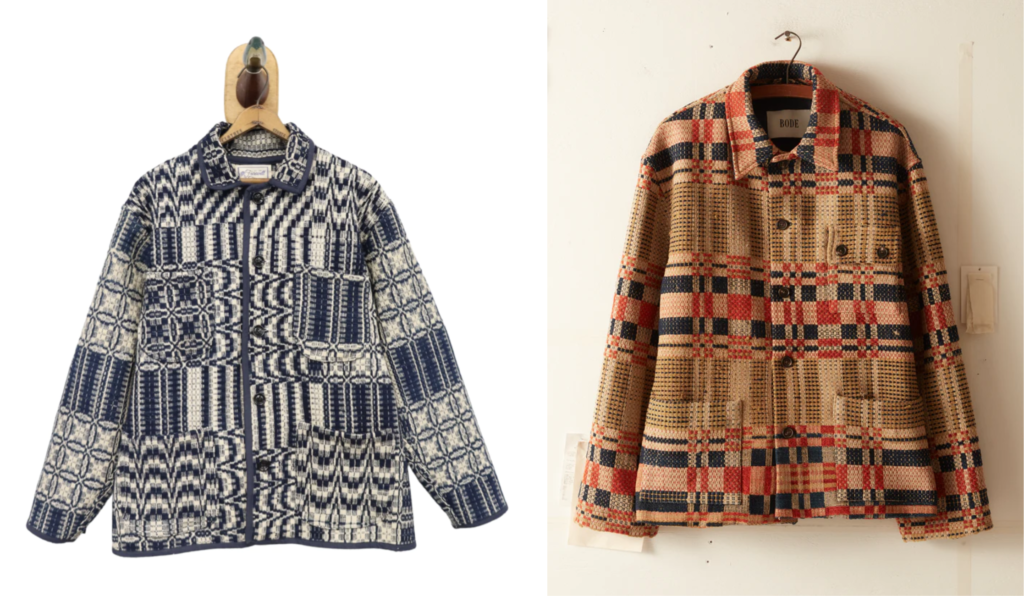
Left jacket is from Farewell Frances; Right jacket is by Bode
I really love these coverlet jackets that were (are?) trendy a while back, but without having my own coverlet to hack up, and a severe lack in sewing skills, I used this as one of my sources of inspiration. I loved the bold, geometric overshot designs, and the density of the fabric and how it fell.
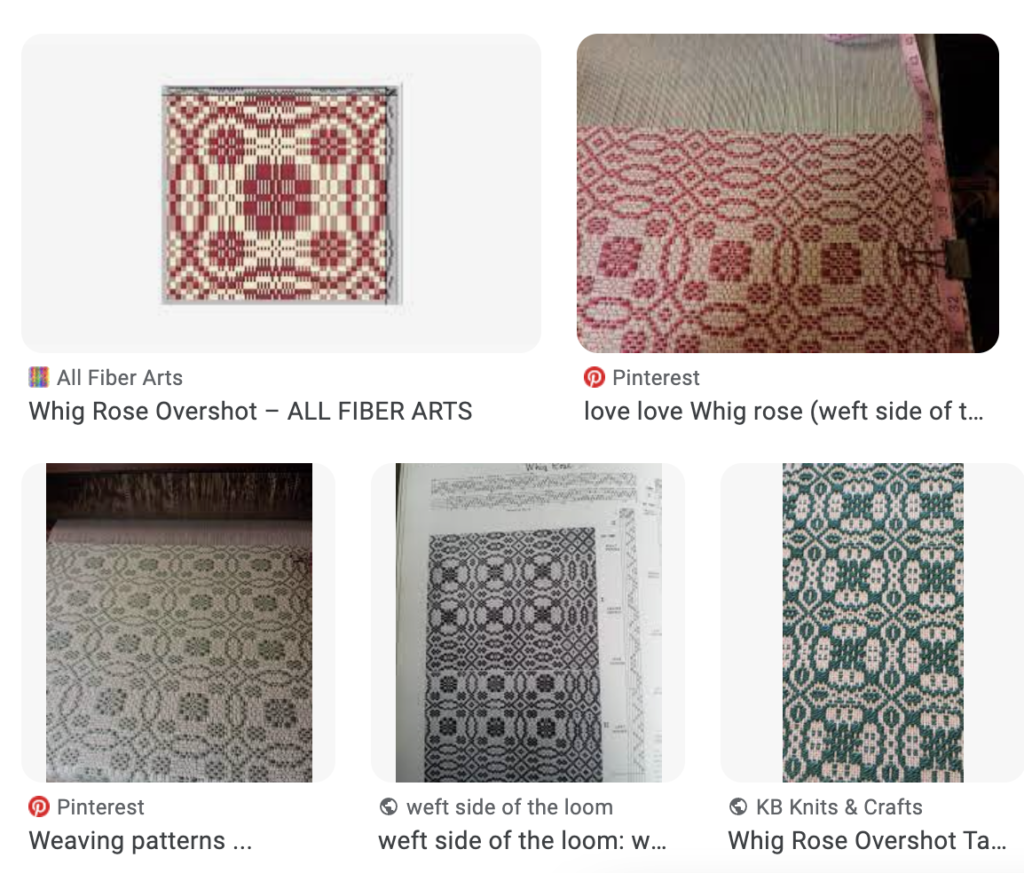
I knew I wanted something that was more cozy sweatshirt than jacket-like, and I also knew that I wanted to use the traditional Whig Rose pattern that I absolutely love.
Some Whig Rose examples from googling
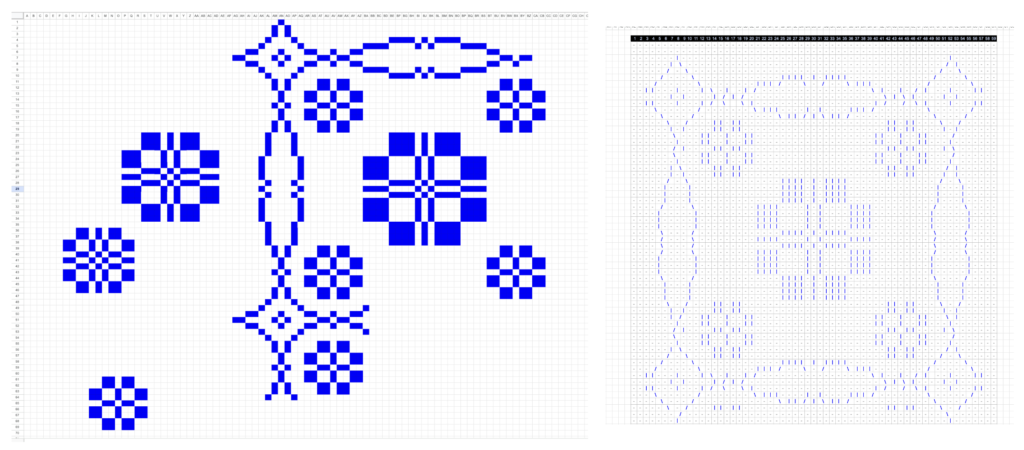
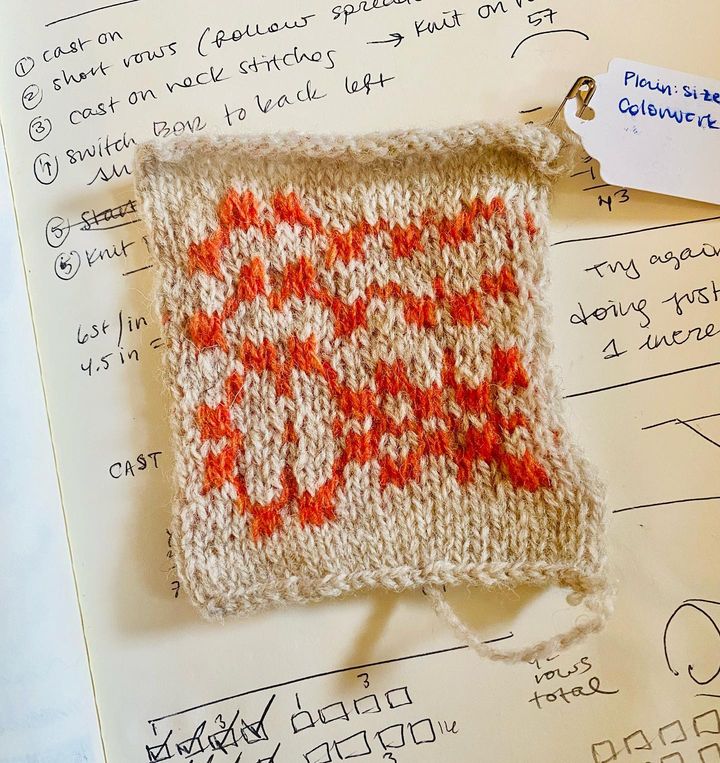
The next step was figuring out how to translate that pattern into a chart. I can’t show the final chart here since it is part of the publication, but here are a couple versions I tried along the way:
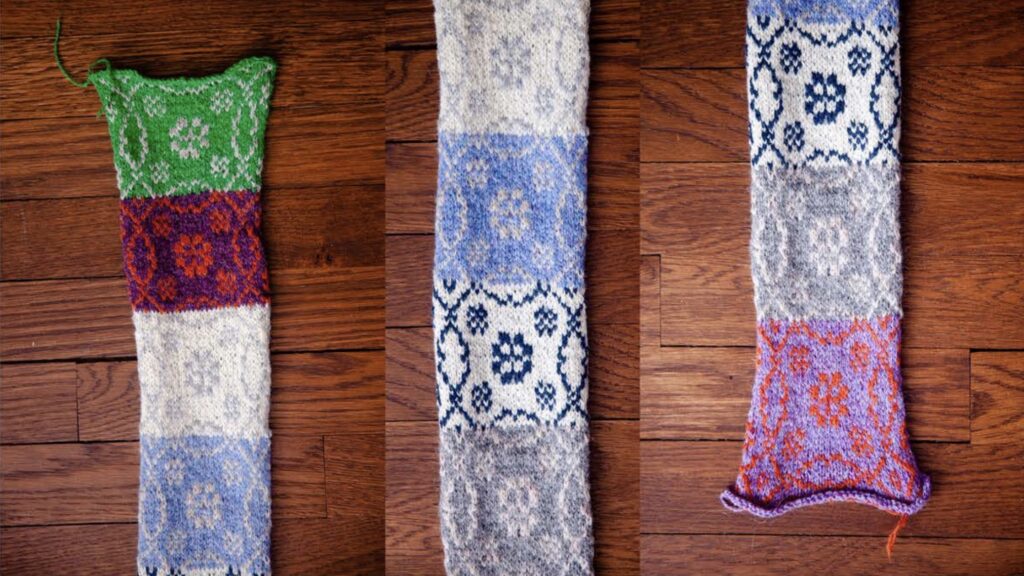
Next came swatching. I had a vision for purple and orange, but I didn’t have the right colors in my stash, so I tried out a ton of different options. In the end, I also loved the green, soft blue, and more traditional blue on white versions.
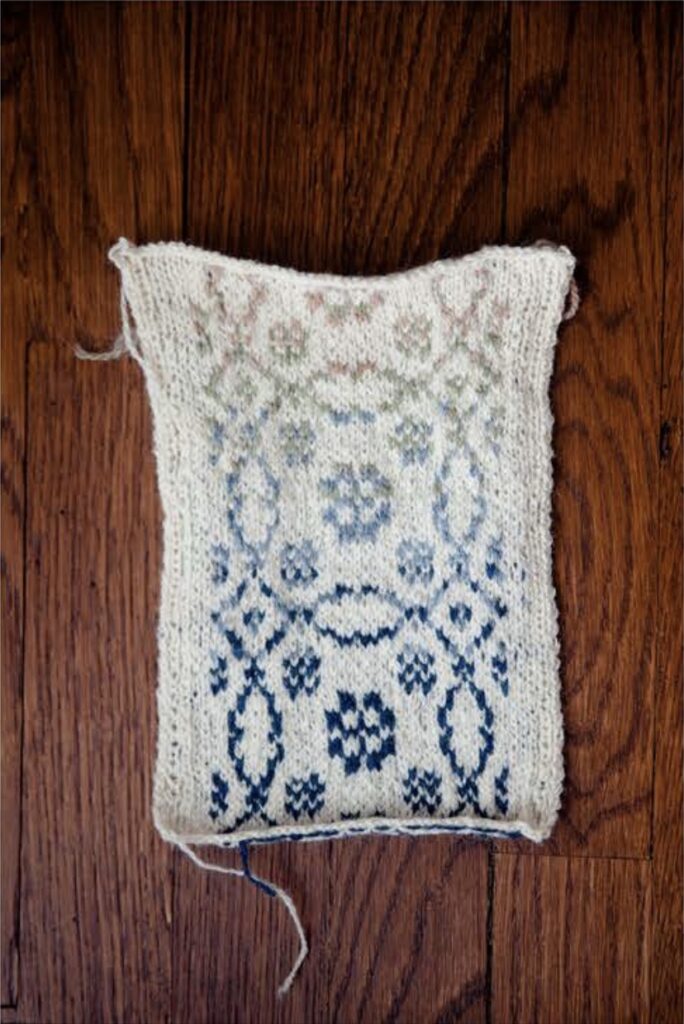
I also tried a gradient version that I would have LOVED to see knit as a full sweater, but in the end, I’m so thankful I didn’t have to knit that for the sample.
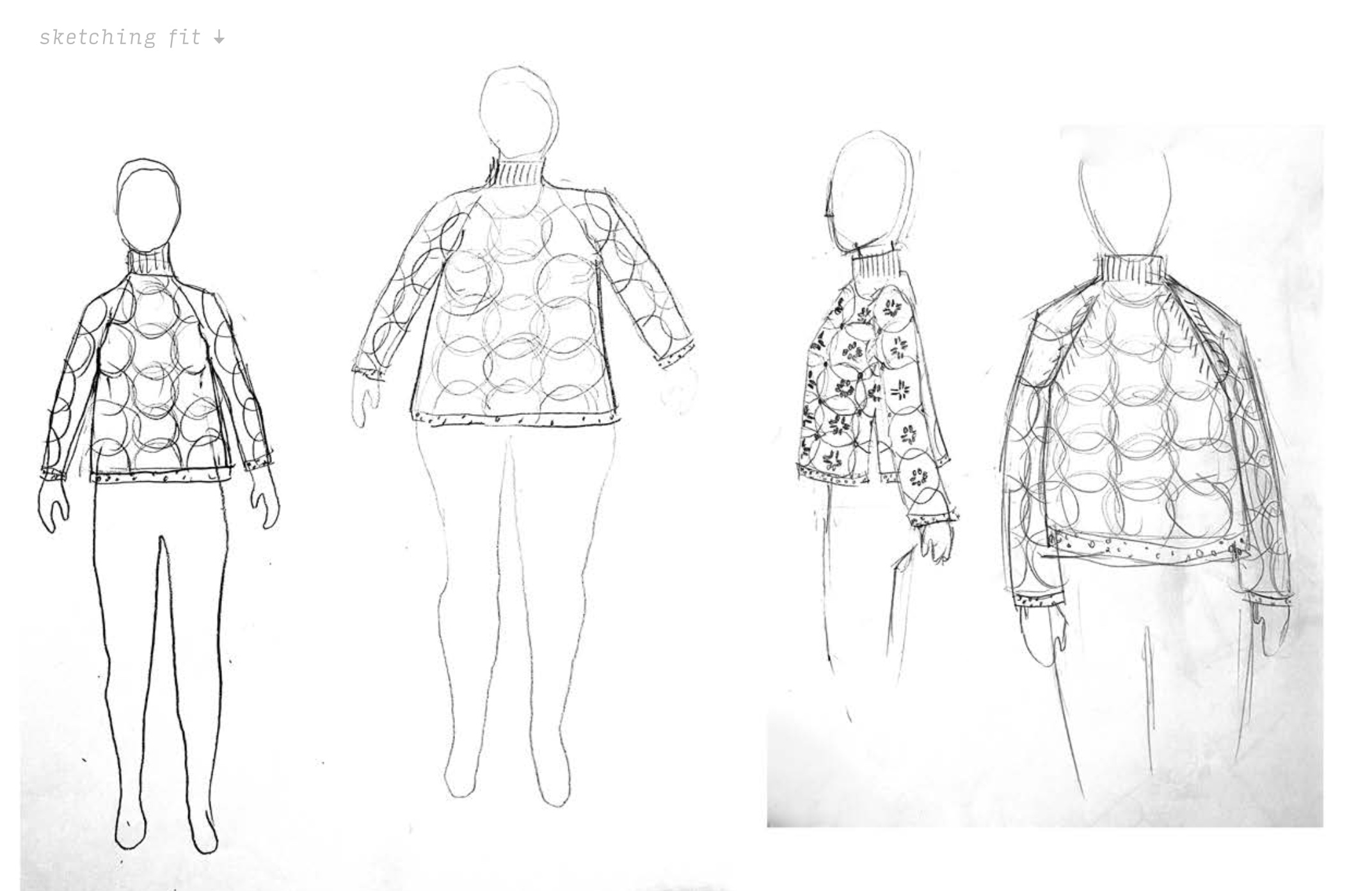
The last part of the submission was to suggest yarns (I suggested traditional colorwork yarns like Jameison’s of Shetland Spindrift and Harrisville Designs Shetland), and to add a sketch of how you intended for it to fit on the body:
Then it was time to wait.
I finally heard back a few weeks later that Pom Pom would love to have me create the pattern I had dreamed up! I was so excited, but having never written a pattern before, I was also definitely freaking out and wanted to figure out a lot of design details before I even tried knitting up the sample.
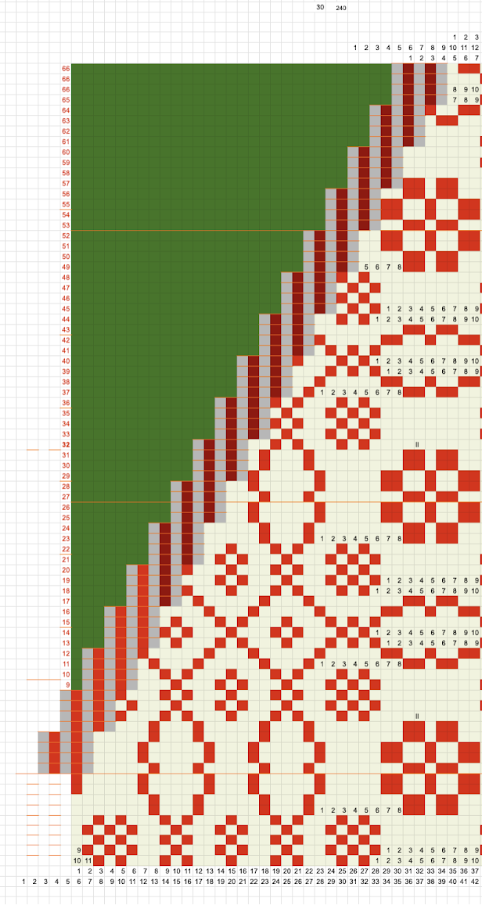
I knew that for a more casual fit, I wanted raglan shaping. But I also knew that a) I always struggle with the fit of top-down raglans, b) I wanted to knit this in the round with steeks, and c) I just really like bottom up sweaters (don’t @ me~~~). So I started using my favorite knitting sketching tool, Google Sheets, to try to figure out the shaping I would need and how I could do raglan decreases with steeks (Note: this is not the final shaping in the pattern, and the pattern repeat is intentionally cut off here, given that the pattern rights are owned by Pom Pom).
I also knew I wanted a folded hem, and that I needed to figure out the overall shaping of the sleeves. All of this was sketched out using Google Sheets. Once the pattern rights are back to me, I’ll upload a few more of those screenshots.
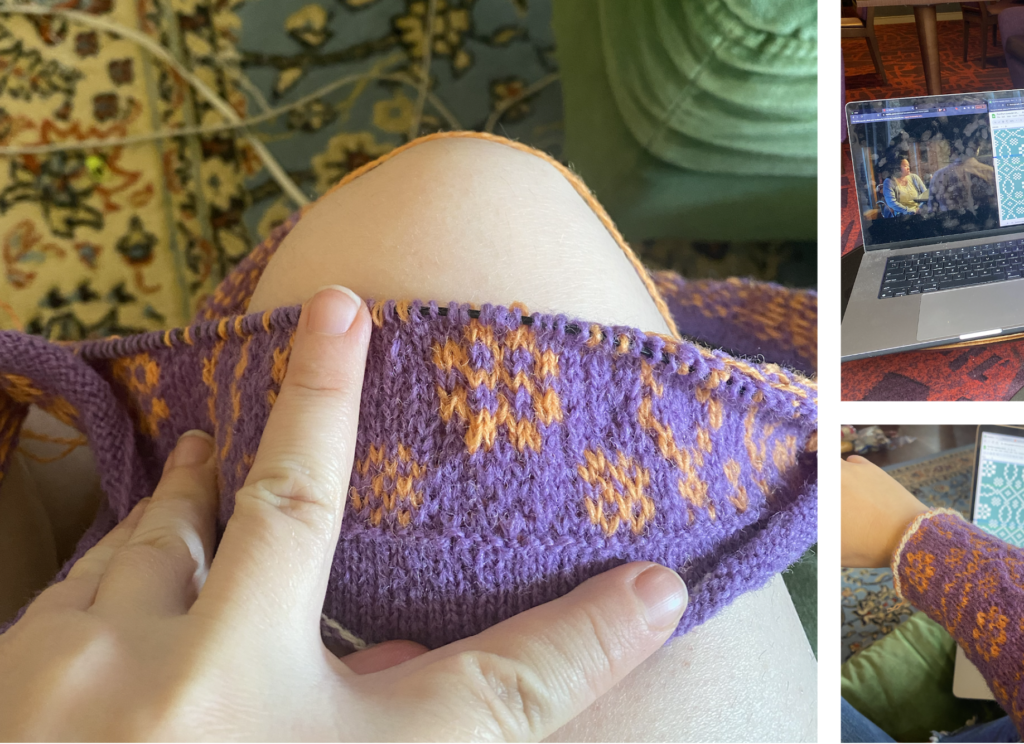
Then it came time to KNIT KNIT KNIT. I’m a fast knitter, but this definitely put my skills to the test. I think the gauge for this pattern is really tight as a result 😂 The yarn, being Jamieson’s of Shetland and coming from the middle of the north sea, took forever to get to me. It cut my sample knitting time down by…a lot…So I was already in crunch mode.
Unfortunately, this being my first pattern, and being someone that usually knits off of cones and doesn’t think about yardage, I completely underestimated how much yarn I needed and panic set in…
But luckily, through a very strange, happy coincidence, I was going to Shetland that summer – the land of wool.
And I was able to pick up a nice little cone of the Anenome color at their flagship store in Lerwick. [First] crisis averted.
With plenty of yarn in hand, and only days to finish up the knitting, I continued along. I got to the point of cutting the steeks, attaching the sleeves, and figuring out the plan for the neck.
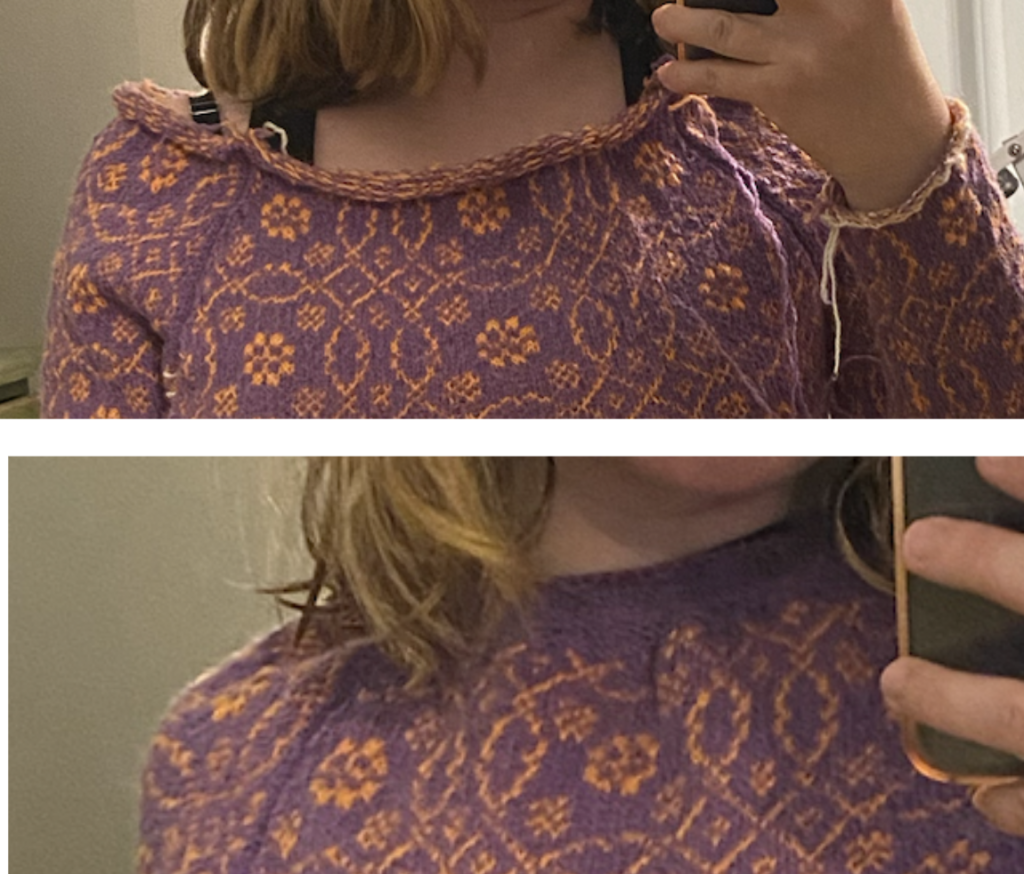
I was pretty pissed off when I realized that my neck shaping had not worked as planned, and I ended up with more of a V-neck or henley shape, than a tight fitting crew like I wanted.
SO, it was time to un-attach(?) the sleeves from the front, rip out the neck, and reknit the whole front neck with brand new steeks and shaping 🙃
And voila! A beautiful, tight fitting neckline. Second (and final) crisis averted.
So next time anyone tells you you can’t “fix” a sweater after cutting open a steek, you can tell them that’s a lie. They’re just not crazy enough (or working against a contract deadline).
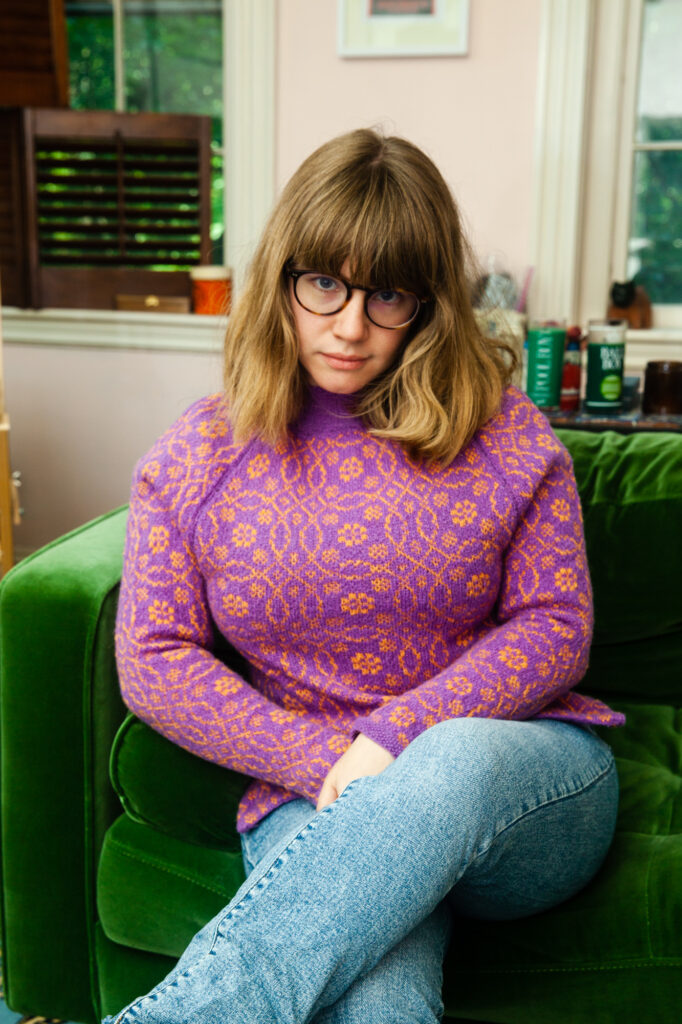
And finally, I had a beautiful finished sweater!
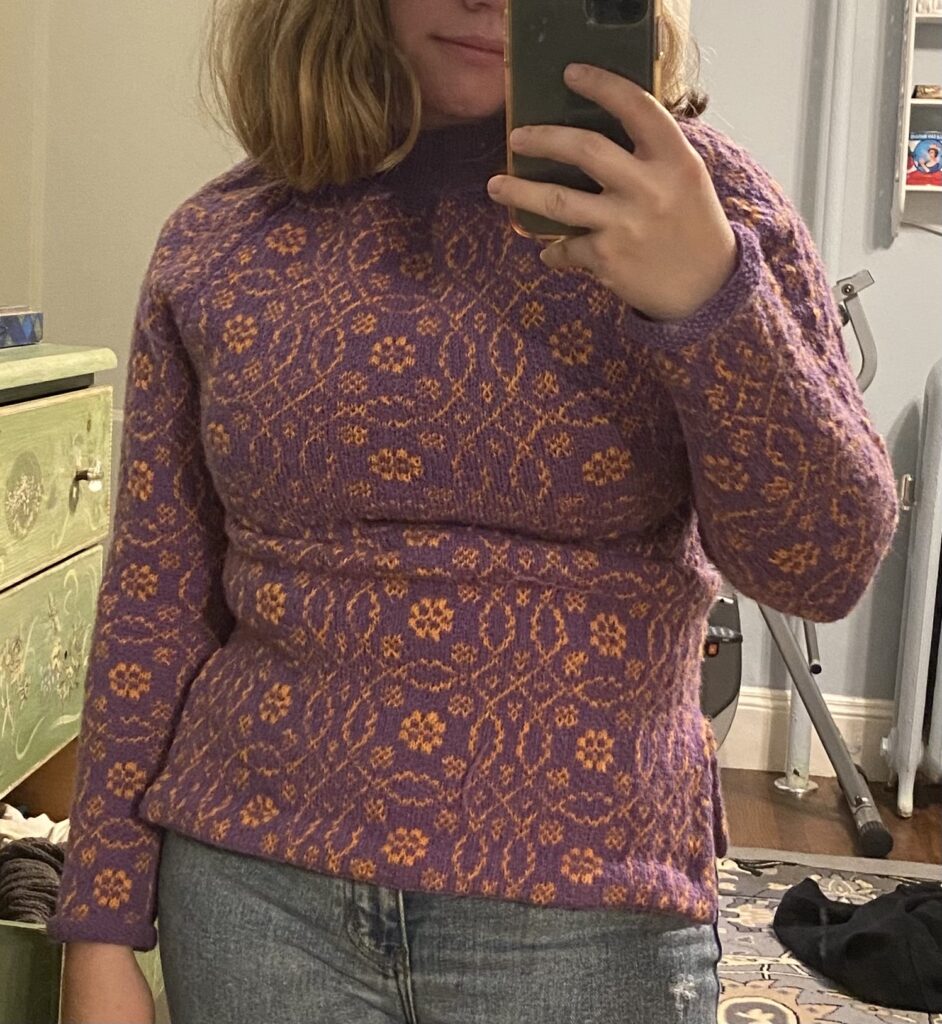
In the end, the fit came out a bit tighter than I had intended, but I think the final result is a really eye-catching piece that can be styled up or down. I also think this pattern can be used as an amazing canvas to play with color combos. For a looser, more cropped and casual fit like my original intention, you can size up and knit one or two fewer vertical repeats, which is what I plan to do for my second sample that is already in the works!
Overall I’m so excited to be part of this amazing, and sadly final, publication from Pom Pom. I want to thank the Pom Pom team for giving me a chance and publishing my very first pattern, and the Jameison’s of Shetland team for putting together that special cone of yarn for me and having it ready for pick up during my much too short stay in Shetland.
Pom Pom magazine photos are shot by Diana Ascarrunz @dianascarrunz; and shown here courtesy of Pom Pom @pompommag
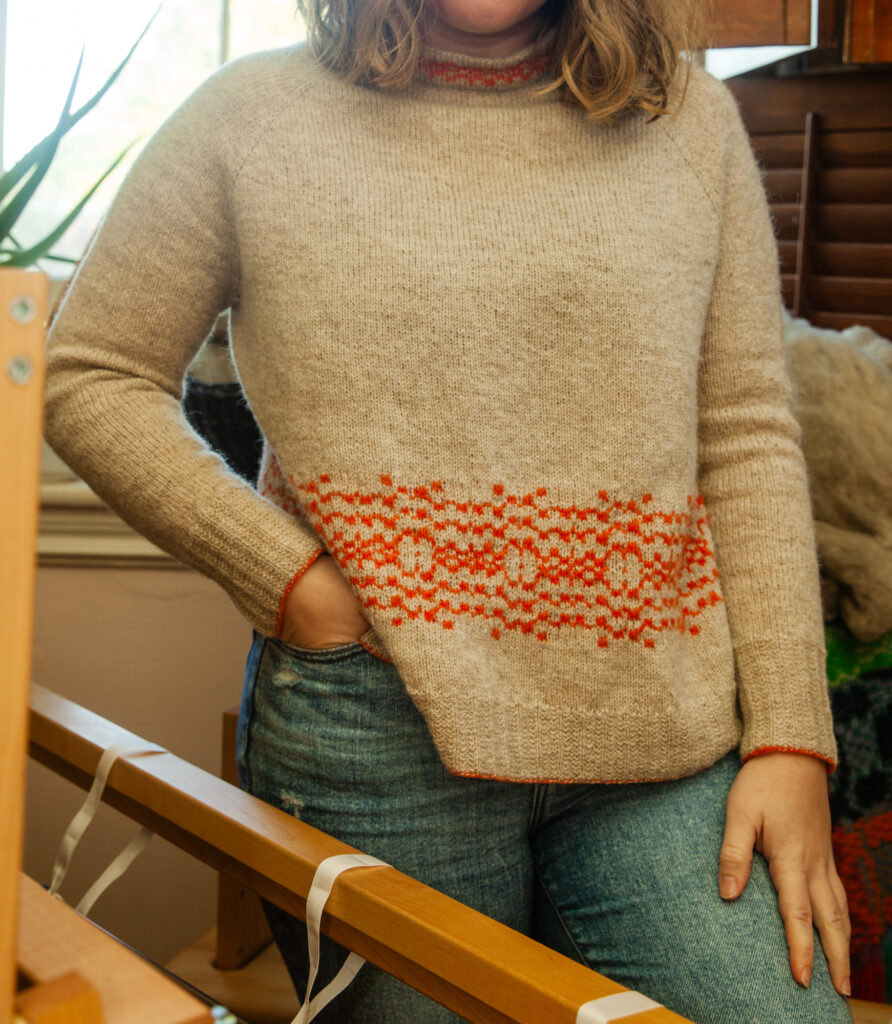
I’m so excited to be able to announce my first self-published knitting pattern! The pattern is called Ann. It is named after the weaver who wove a coverlet using the pattern the colorwork is based on.
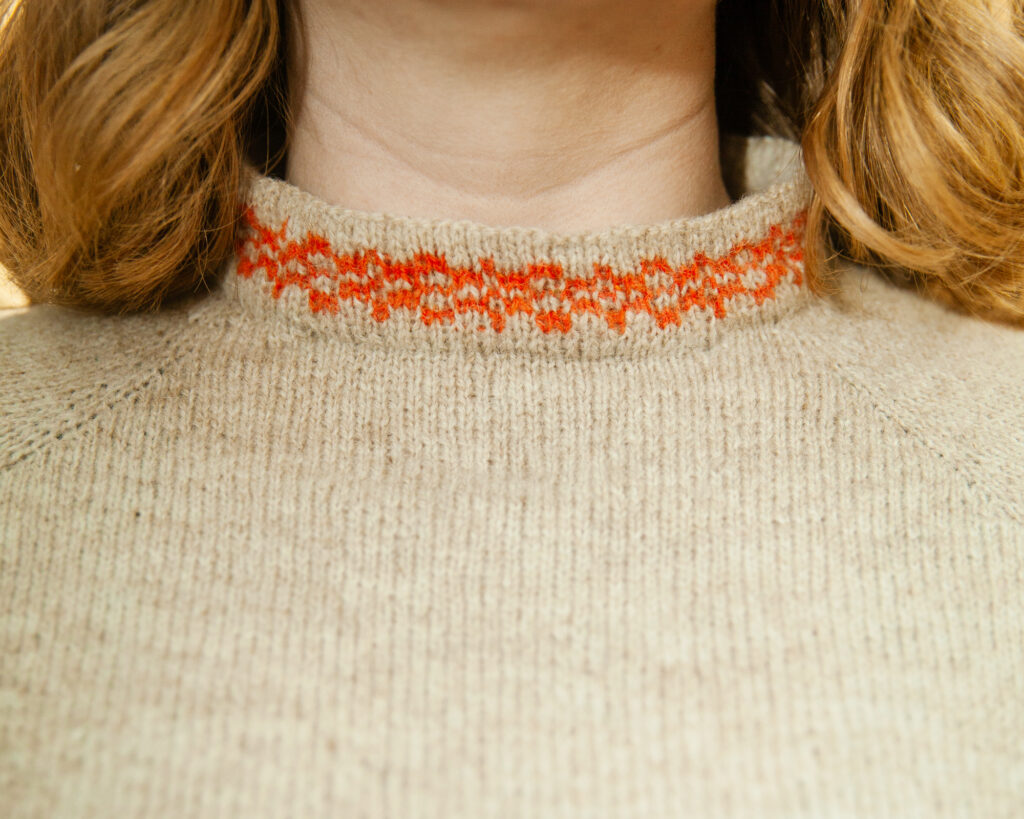
Ann is a top-down raglan that is knit in the round. It is has a colorwork folded-over collar, colorwork along the body, and mistake rib hems that end with a contrasting cast-off.
I chose to make this pattern pay-what-you-wish because I currently do not have the audience to run a full test knit, and I wanted to practice getting something out there and ideally build up my following in order to be able to do that some day.
One day, I hope to be able to work on my sheep farm, writing patterns, and releasing beautiful knitting books. Any support you can lend by purchasing, sharing, and/or knitting my pattern helps me work towards getting there.
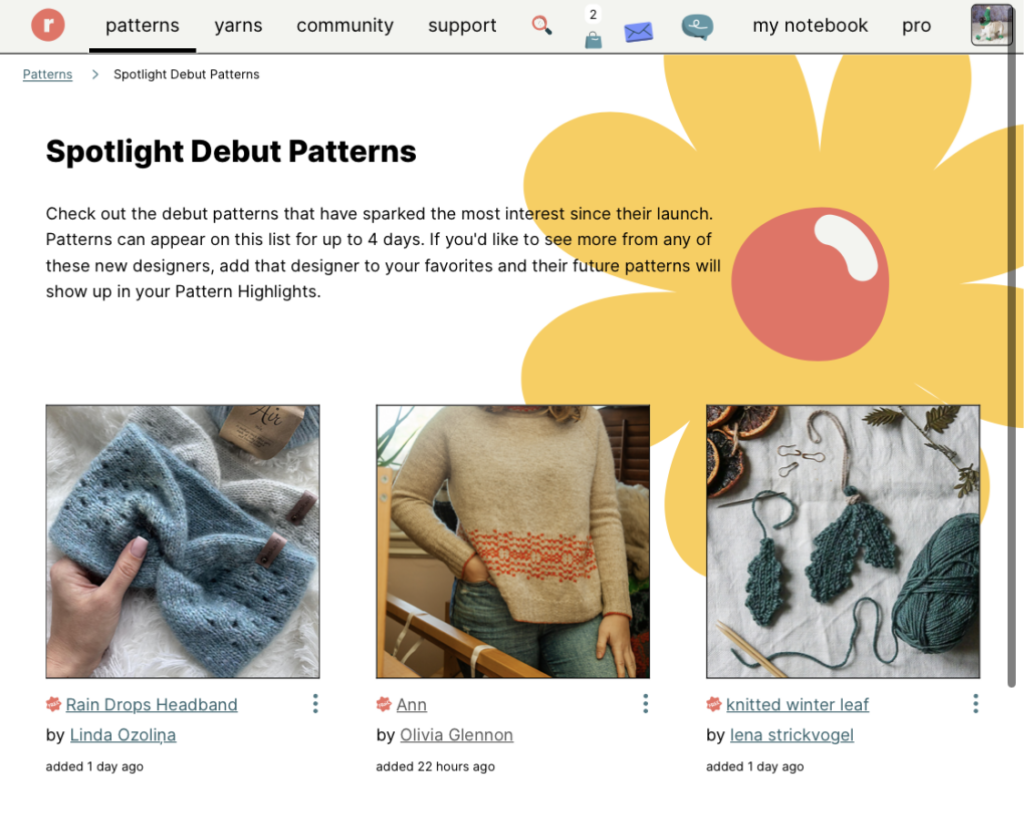
I was so excited to see Ann make it to the 2nd slot on the Spolight Debut Patterns page on Ravelry!
Especially since picking up spinning and finding more local farms and fiber events, it‘s been so hard to resist buying up what is often limited availability yarn and fiber.
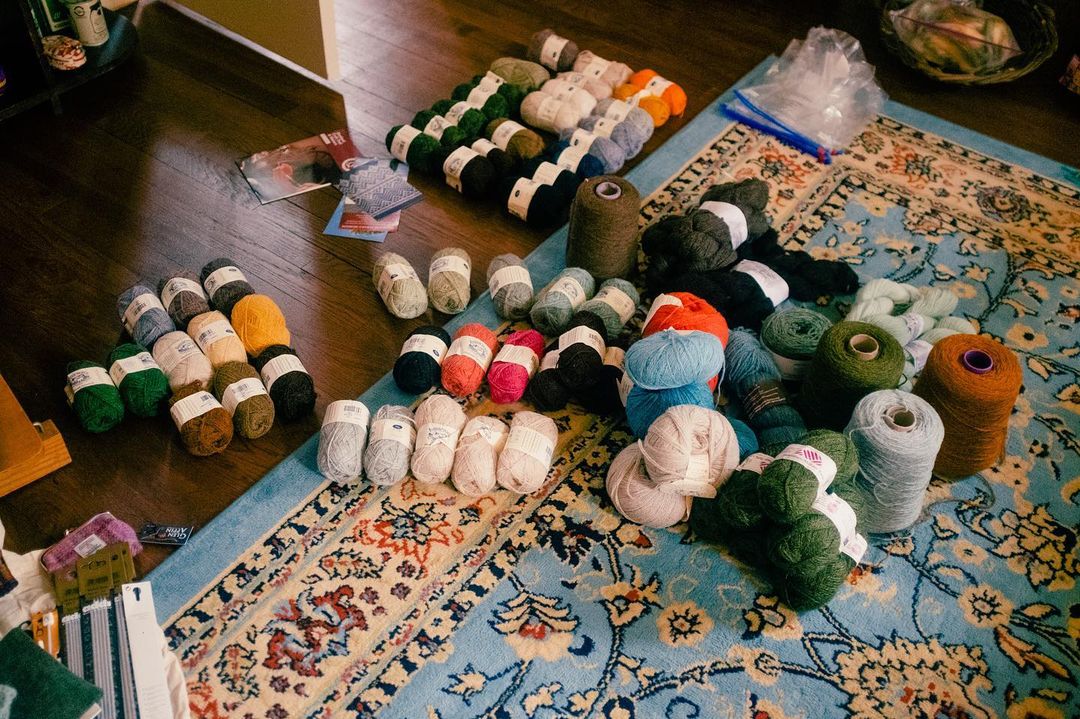
This is the yarn I got in Scotland alone…
But, my apartment is basically turning into a wool dungeon and I’d like to get it under control. So with that, my goal is to not purchase any yarn or fiber for the rest of the year.
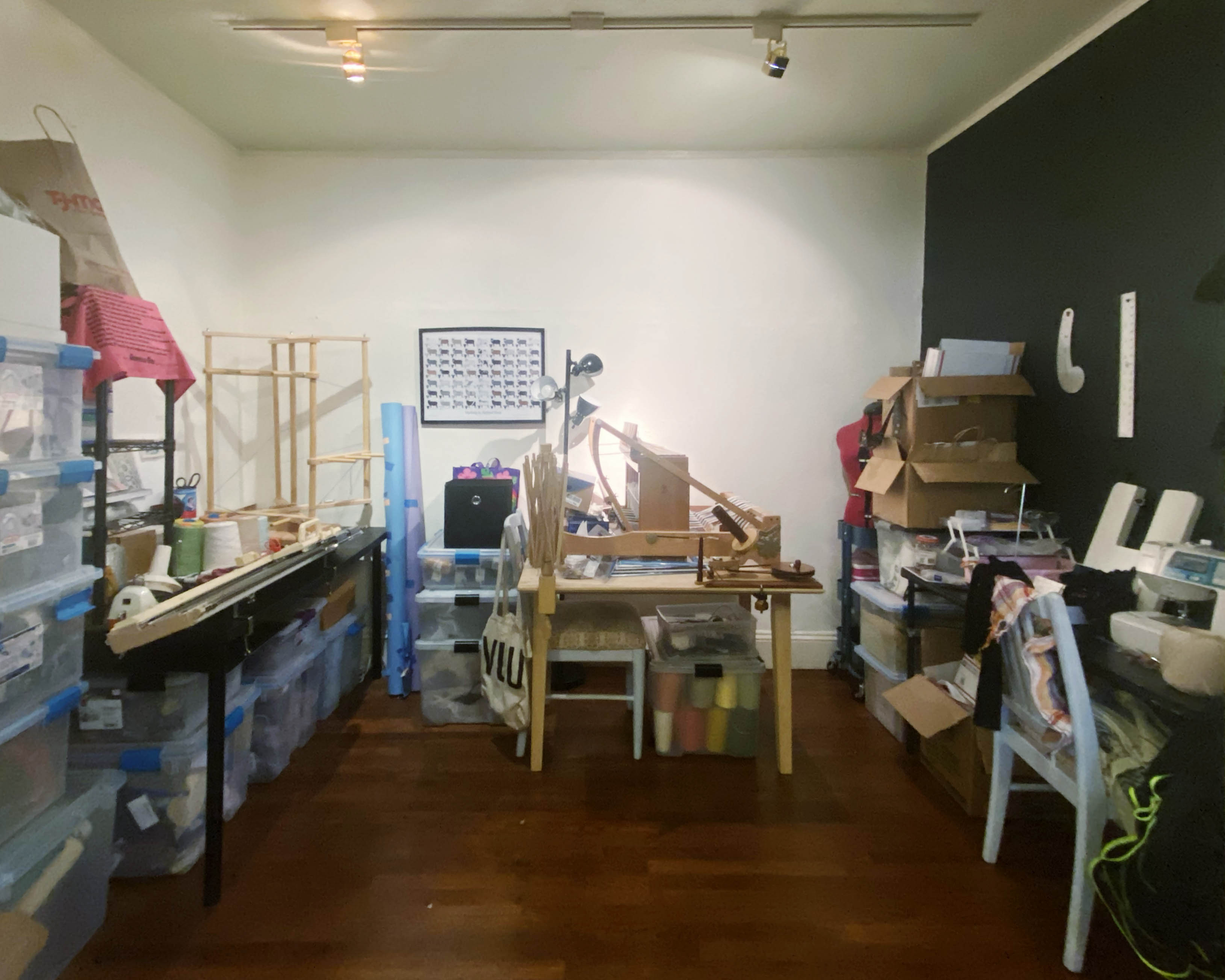
View into my “studio” space in my apartment – which doesn‘t include the bags of Nutiden I’ve since acquired.
My first step is to try to tackle some of the sweater quantities of yarn I have. I have a few projects in mind for those: 3 Nutiden sweaters – 2 of my own design, a Jamieson’s of Shetland fair isle sweater I want to design, some handspun sweater projects, and a couple of cable knits in some hand-dyedsmall business yarn.
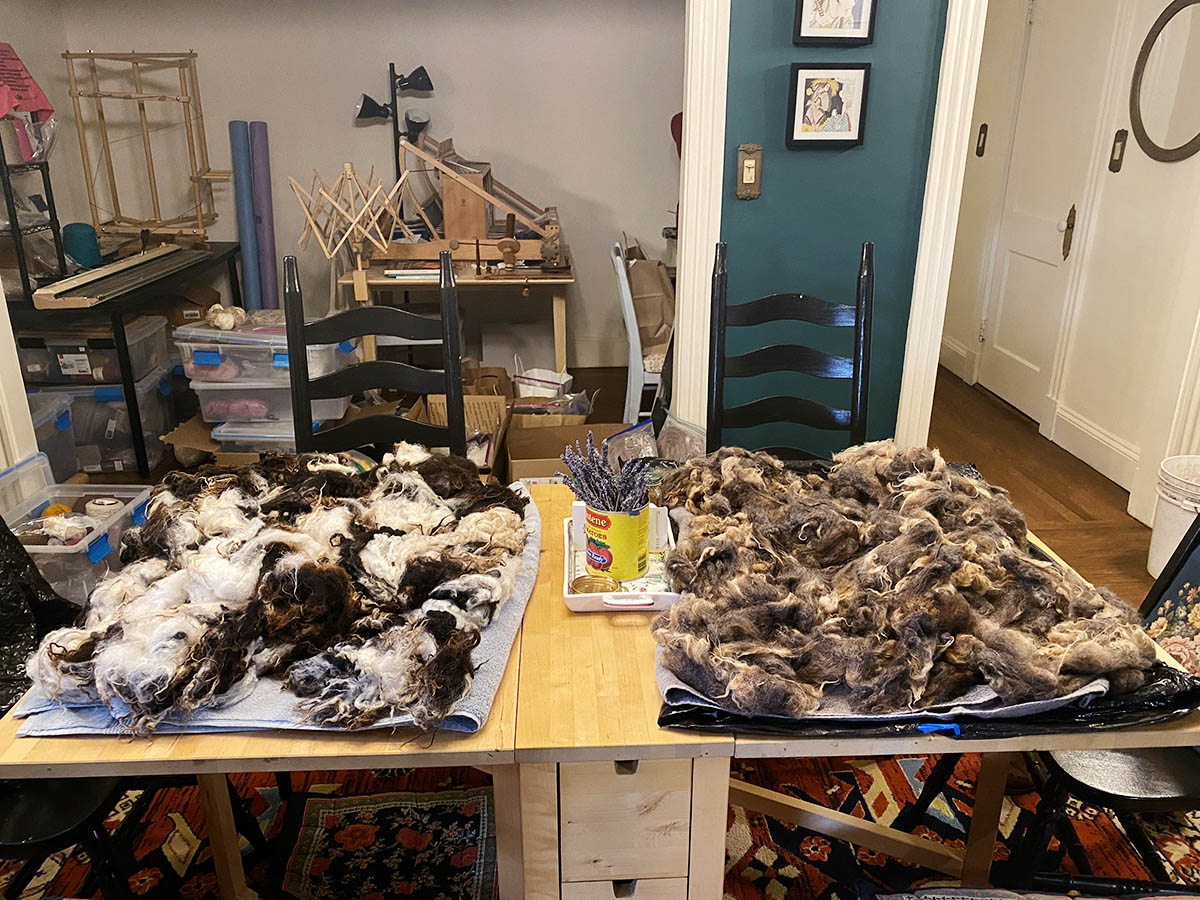
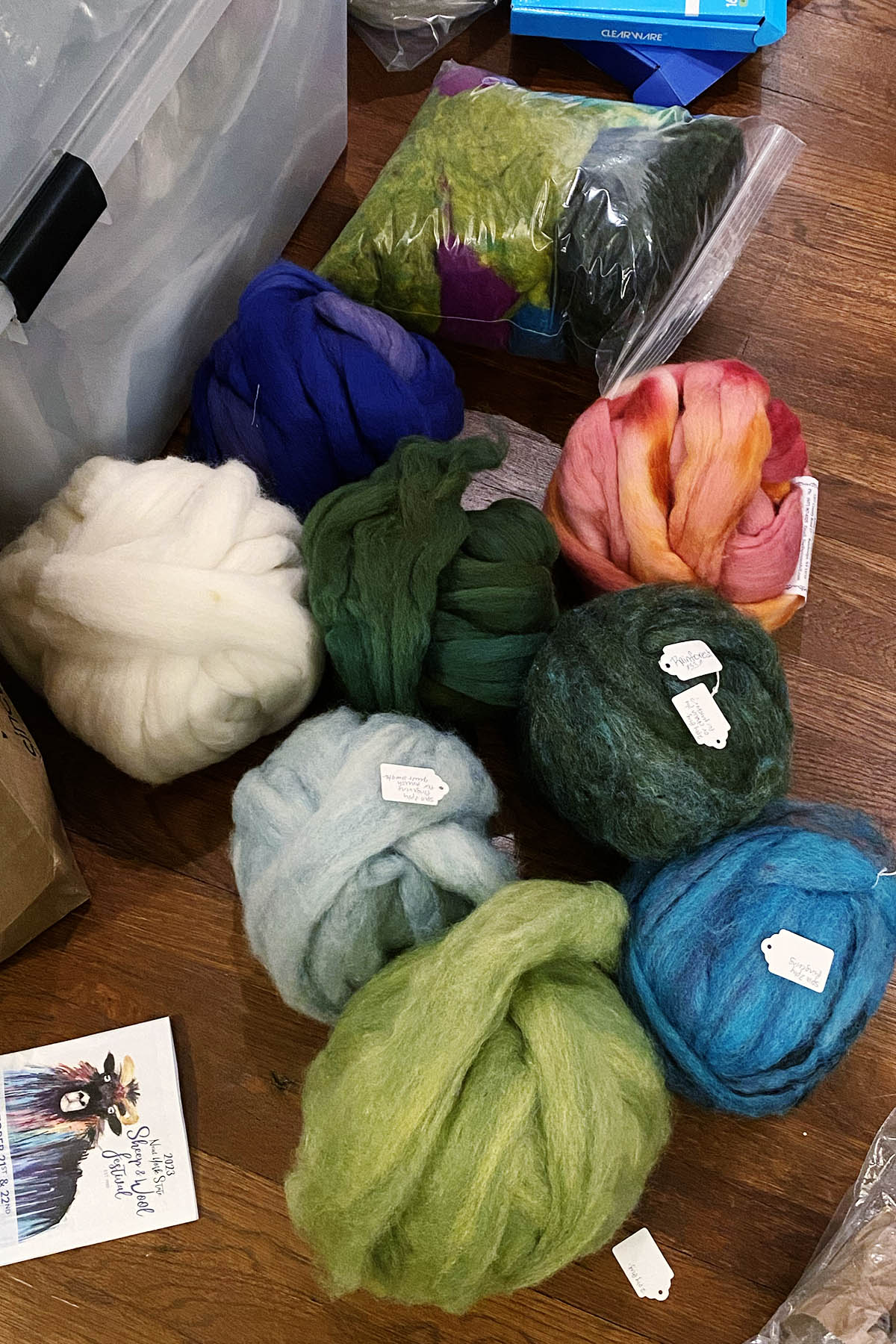
Drying out a few fleeces a couple of months agoThe fun stuff I picked up from Harrisville Designs on my retreat (bag at the top) + Rhinebeck this year
In addition to that, I have a ton of fleece and spinning fiber that I’m so excited to work with – and by turning it into yarn, it will take up less space 😉 I have a few projects in mind for 2-3 of the 7 (lol) fleeces I have.
I’m also planning to document each of these projects here, so stay turned for that.
And then after New Year’s, I’ll see where I’ve landed. I know that as I continue to try to explore designing more, that having a certain amount on hand, especially different colors of 2-ply fingering weight for colorwork, will be helpful for the design process, but I also want to make sure my stash isn’t outgrowing the physical limitations of my space. And, I want to make sure I’m continuing to design, knit, and weave things I’m excited about, not just for the sake of using up yarn.
Anyway, I have a Halloween sweater I need to finish in the next 6 hours, so back to knitting…
Ever since I can remember, I’ve always been “designing” sweaters – whether it was explicitly doodling designs or just the outfits on the people I would draw. The main reason I taught myself how to knit was to be able to create my own designs. Now that I’ve been knitting from other people’s patterns for a few years, I feel like I have a sense of different styles of knitting patterns, what I’m looking for in knitting patterns, and what I would like to contribute to the world of available patterns.
I have tried designing + writing a couple of patterns so far, and already I’ve developed a few guidelines:
I will only do it as long as I enjoy it.
My favorite types of patterns to knit are complex. I will not water-down patterns to make them easier or “more digestible” knits (goes hand-in-hand with item #1). Already I found myself feeling bored with one of my designs because I was trying to keep it simple to write, instead of focusing on just creating what I wanted.
I want to create things that feel like myself and feel like they are worth adding to the literal thousands, if not millions, of knitting patterns out there (also goes hand-in-hand with item #2). I have no interest in designing things that look like elevated basics you could buy at a nice store.
Currently, I don’t have a very large following on Instagram or other platforms, so test knitting would be very hard. I think in order for me to get some things out there and just try, I will have to put out a few patterns without test knitters to start, and hopefully there will be enough interest to have a test knitting group going forward. Fingers crossed 🤞🏻
As for what to expect from me in terms of design…
In all of my creative endeavors – whether that be drawing, photography, or now knitting – I’ve always drawn inspiration from sci fi, witchcraft, horror, but also elements of nature such as rock formations, the ocean, and flowers. And mixed in with that is a lot of inspiration from growing up in New England (think Shaker chairs, fishermen from Maine, and barn looms). A lot of the ideas I’m hoping to explore with my patterns relate back to these themes – delicate black cables in natural black Hebridean yarn worn by girls trying out witchcraft for the first time; women in cults wearing psychedelic colorwork; textures inspired by granite; and chunky cables inspired by ship ropes on the sea.
I hope all of this gets you as excited as I am, and I can’t wait to share some of the things I’ve been working on.
Last month, I was able to do another week-long weaving retreat up at Harrisville Designs in Harrisville, NH. It is one of my favorite activities I do for myself – I find it very relaxing, creatively stimulating, and special.
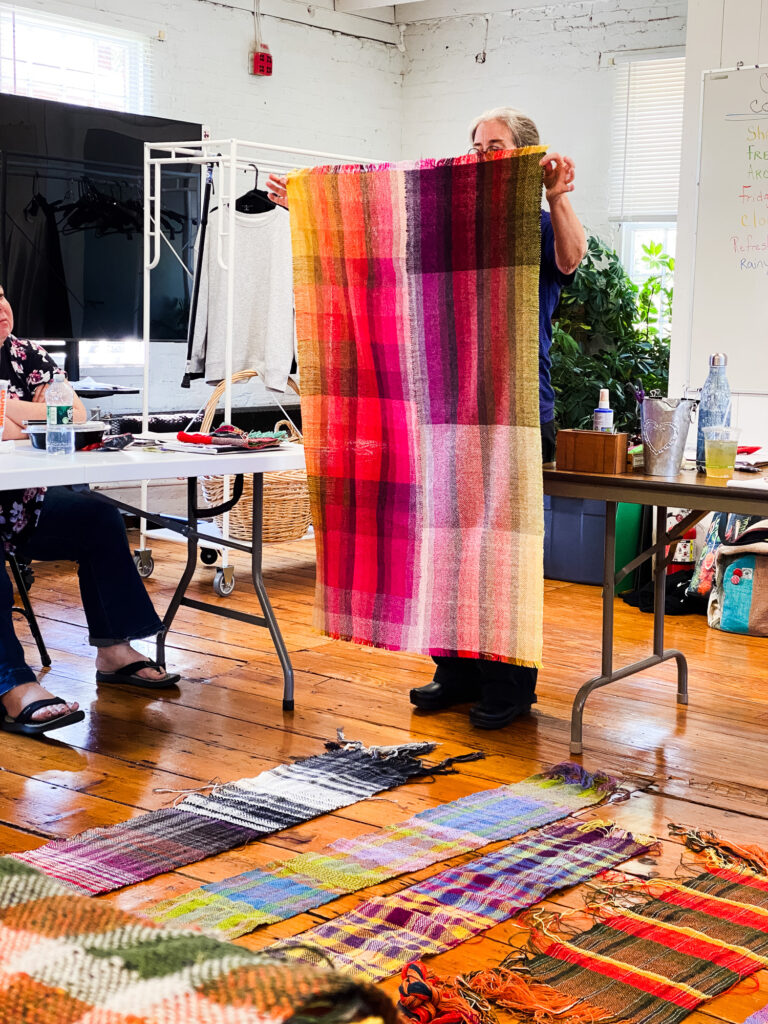
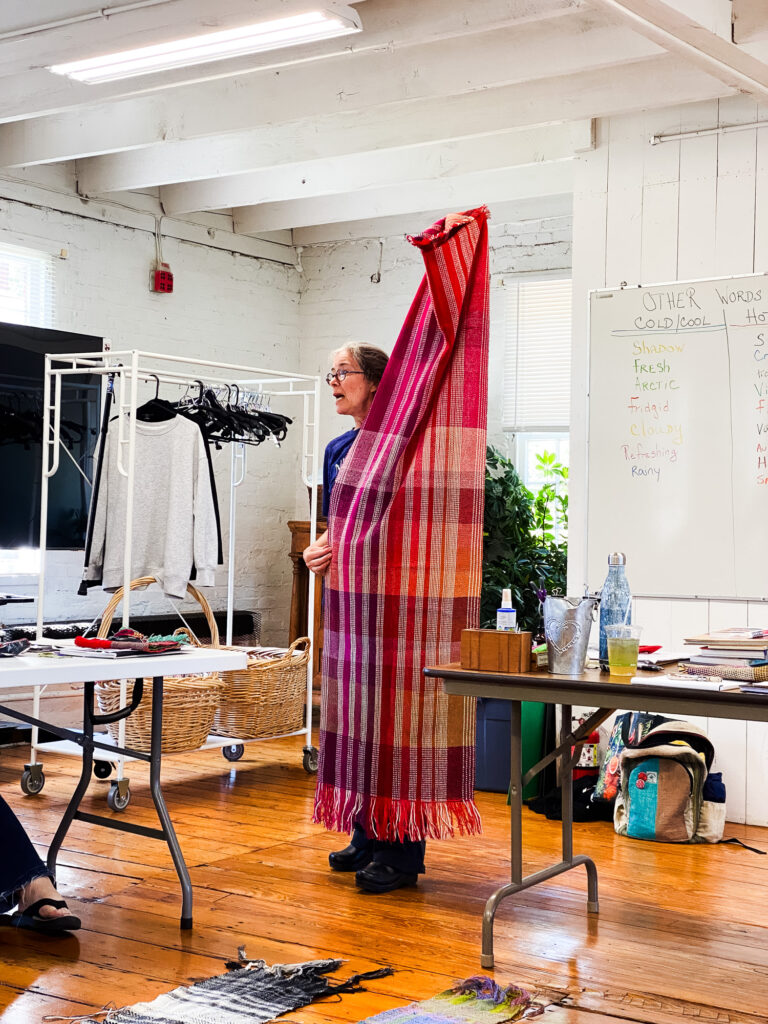
This year, I took their course in color with Megan Karlen. I had taken the course in color with now-retired Tom Jipson, and wanted to see how the course would be with a new teacher. Tom’s class was much more technical, and slower-paced, while Megan’s was much more about cultivating intuition and open. Both were great, and I’m glad to have had the opportunity to attend both.
The retreat is also particularly special due to the preservation of the town. Weavers have the option of staying across the street from the studio at the Boarding House, and everyone has 24 hour access to the facilities. Waking up early and being able to walk over to the studio in the fog is an amazing way to wake up.
One day I would love to have a property where I could host this type of retreat. Being able to stay on site with the studio is so important for being able to destress and focus on freely weaving for the week. Having all the yarn included helps too 😉
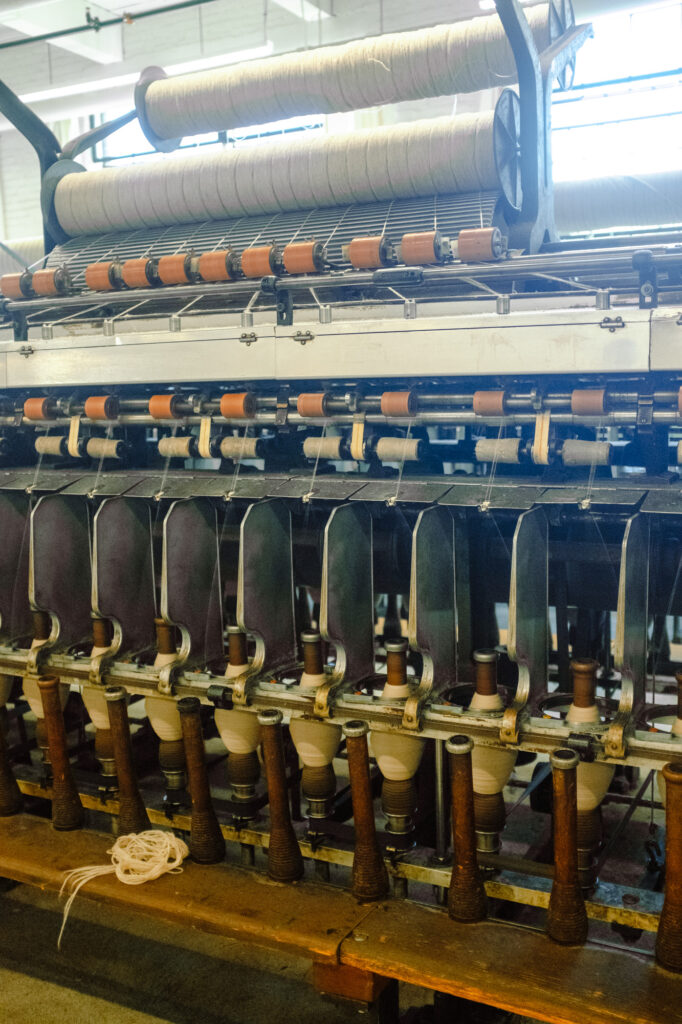
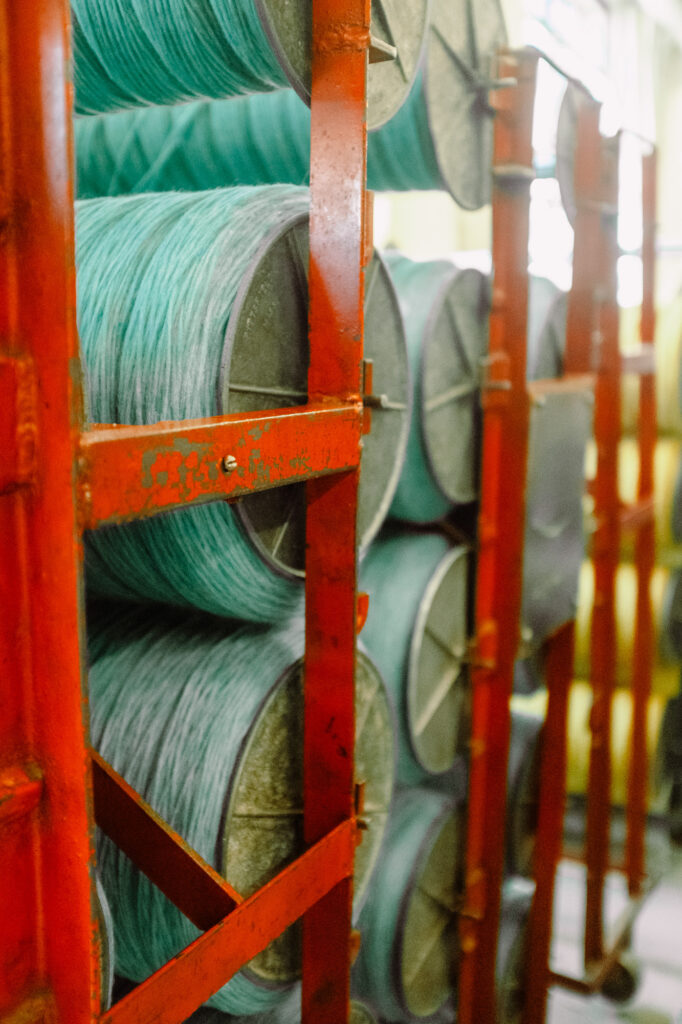
We also got a tour of the recently moved spinning mill! The mill has been moved back into its original historic building, and is now mainly powered by hydro and solar power.
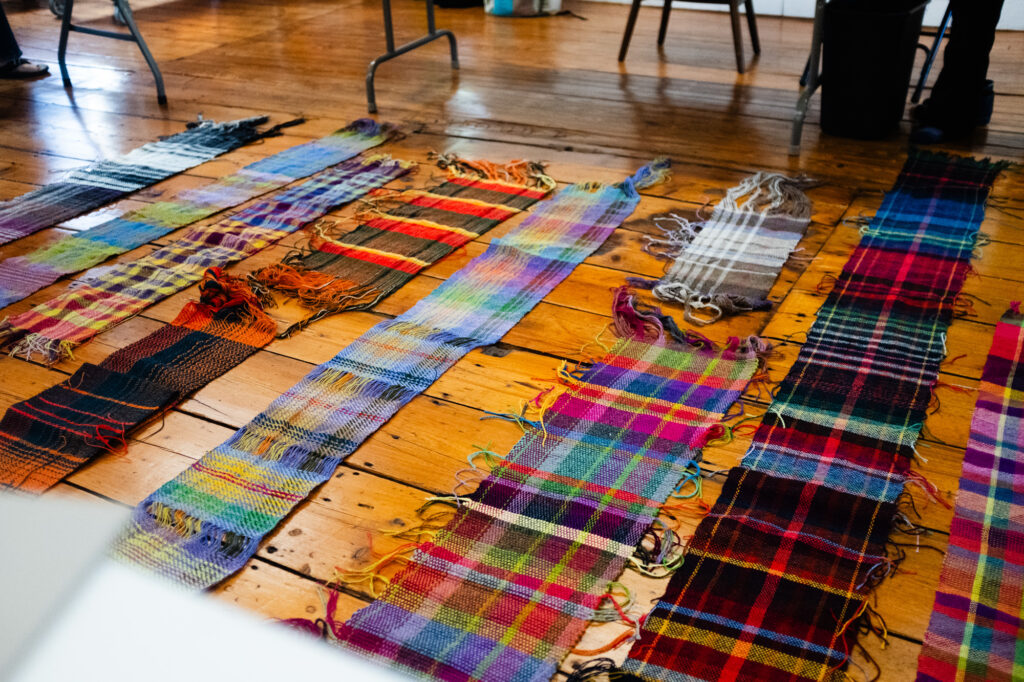
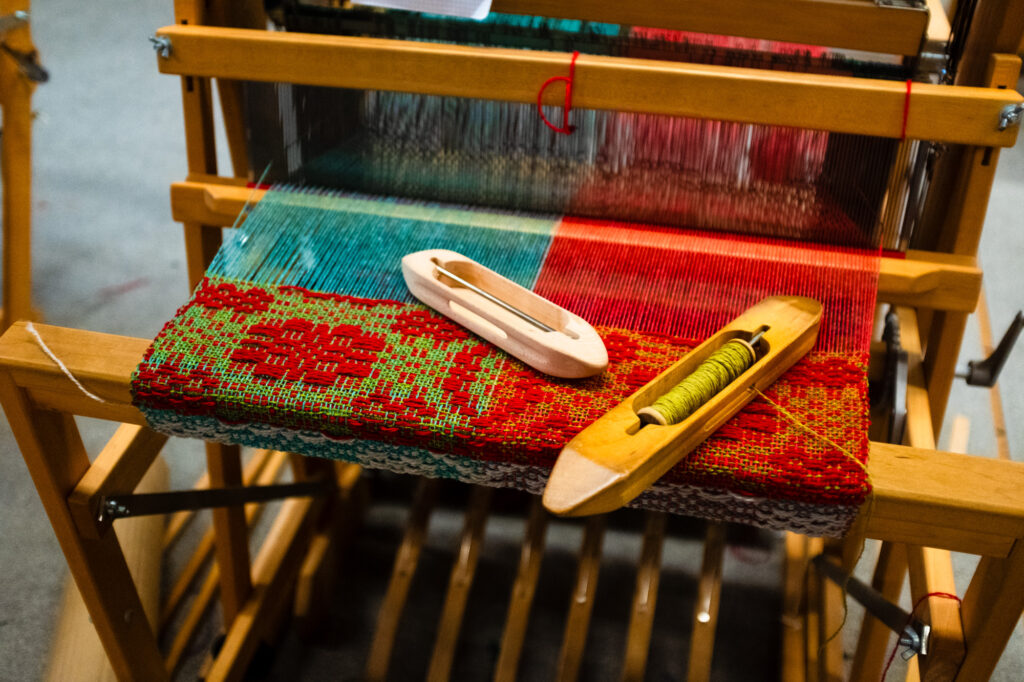
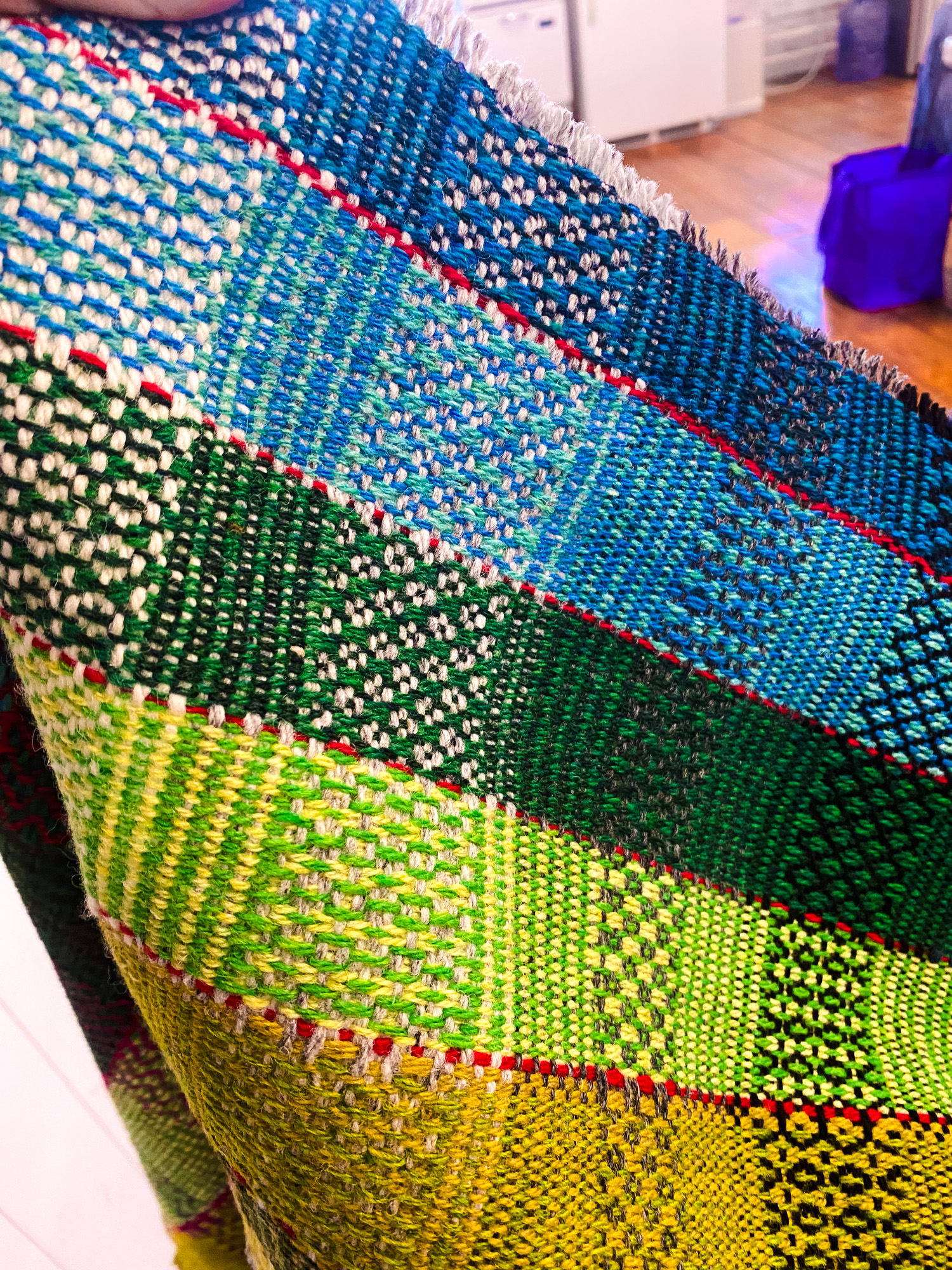
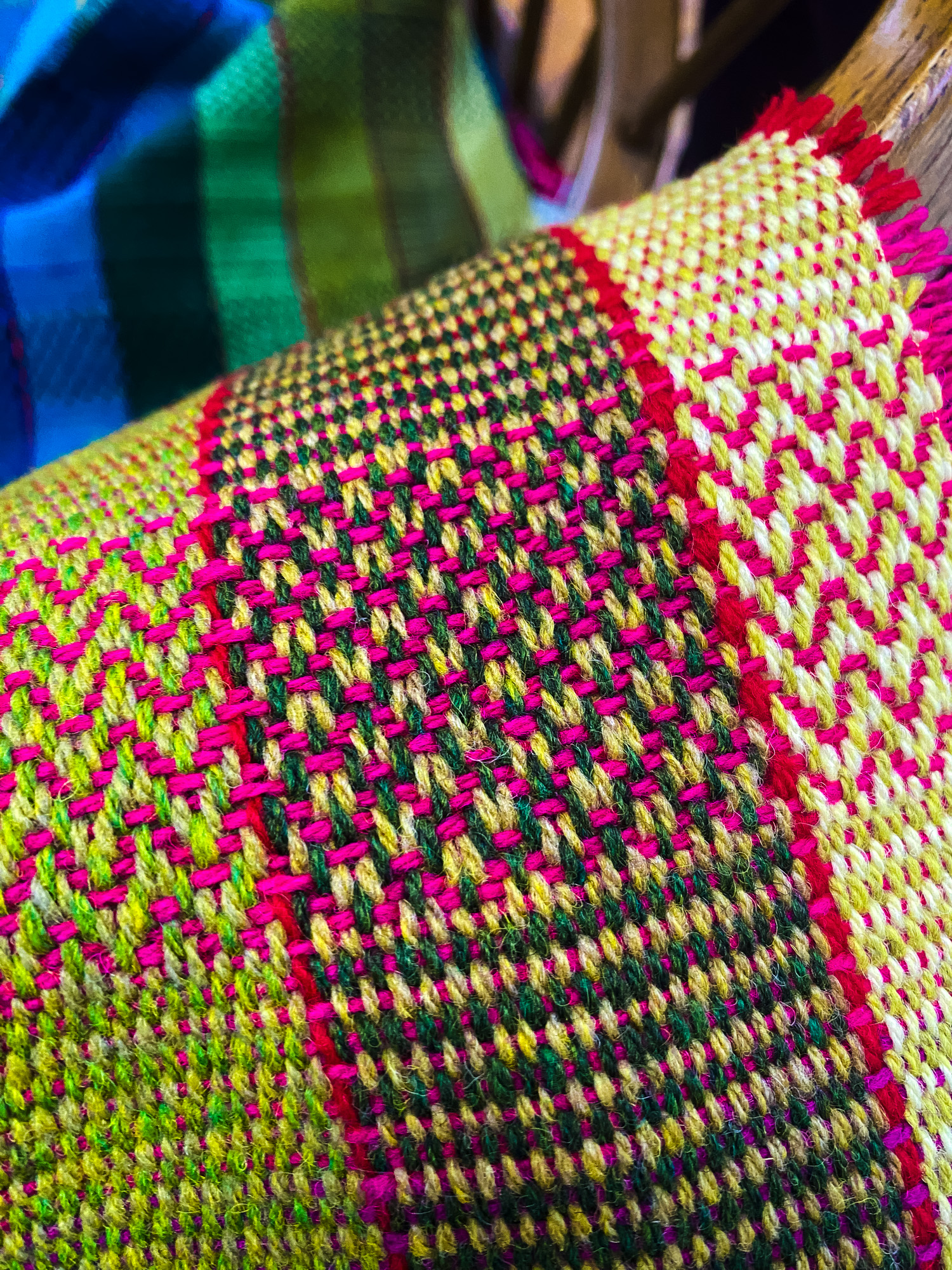
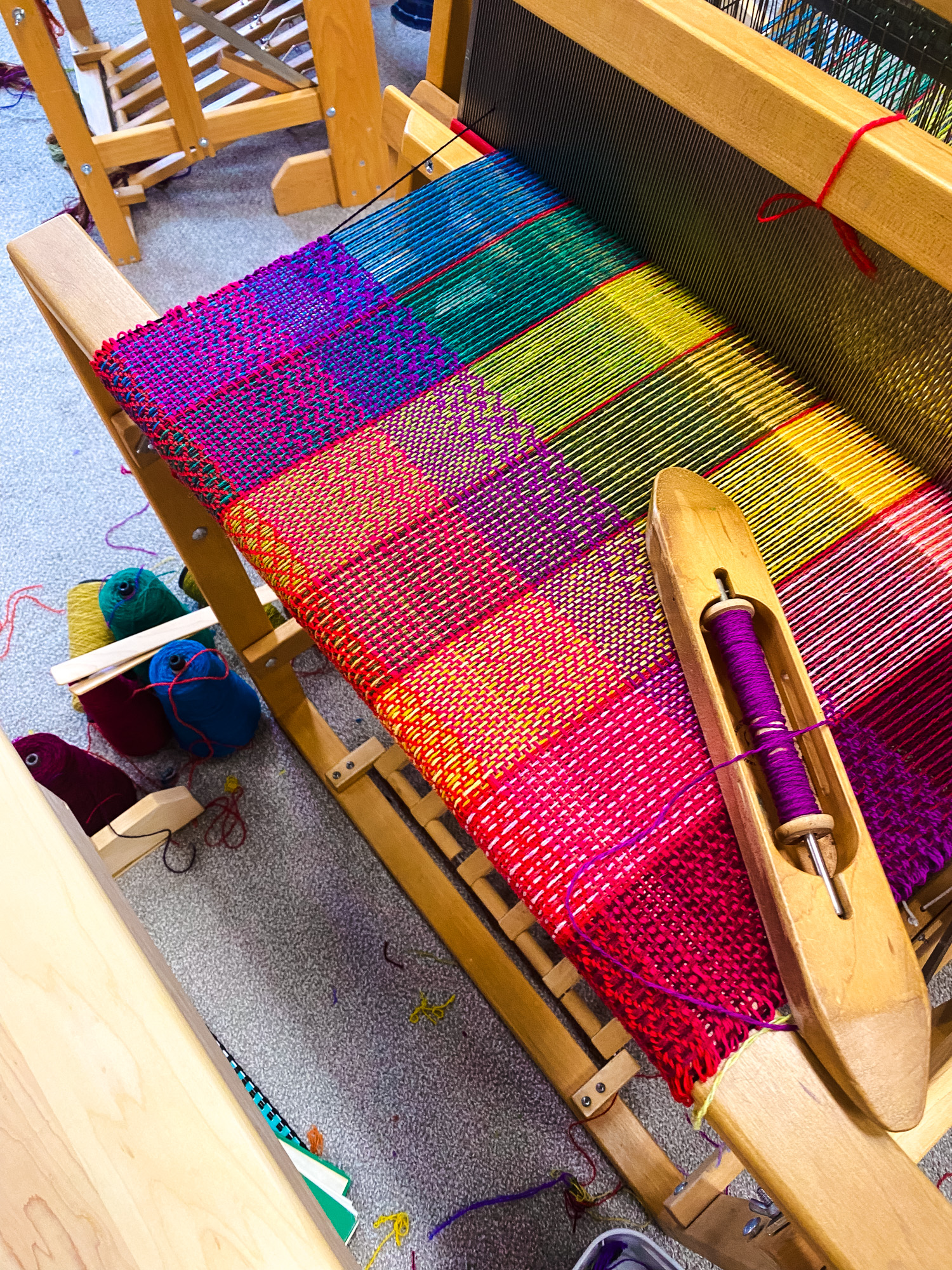
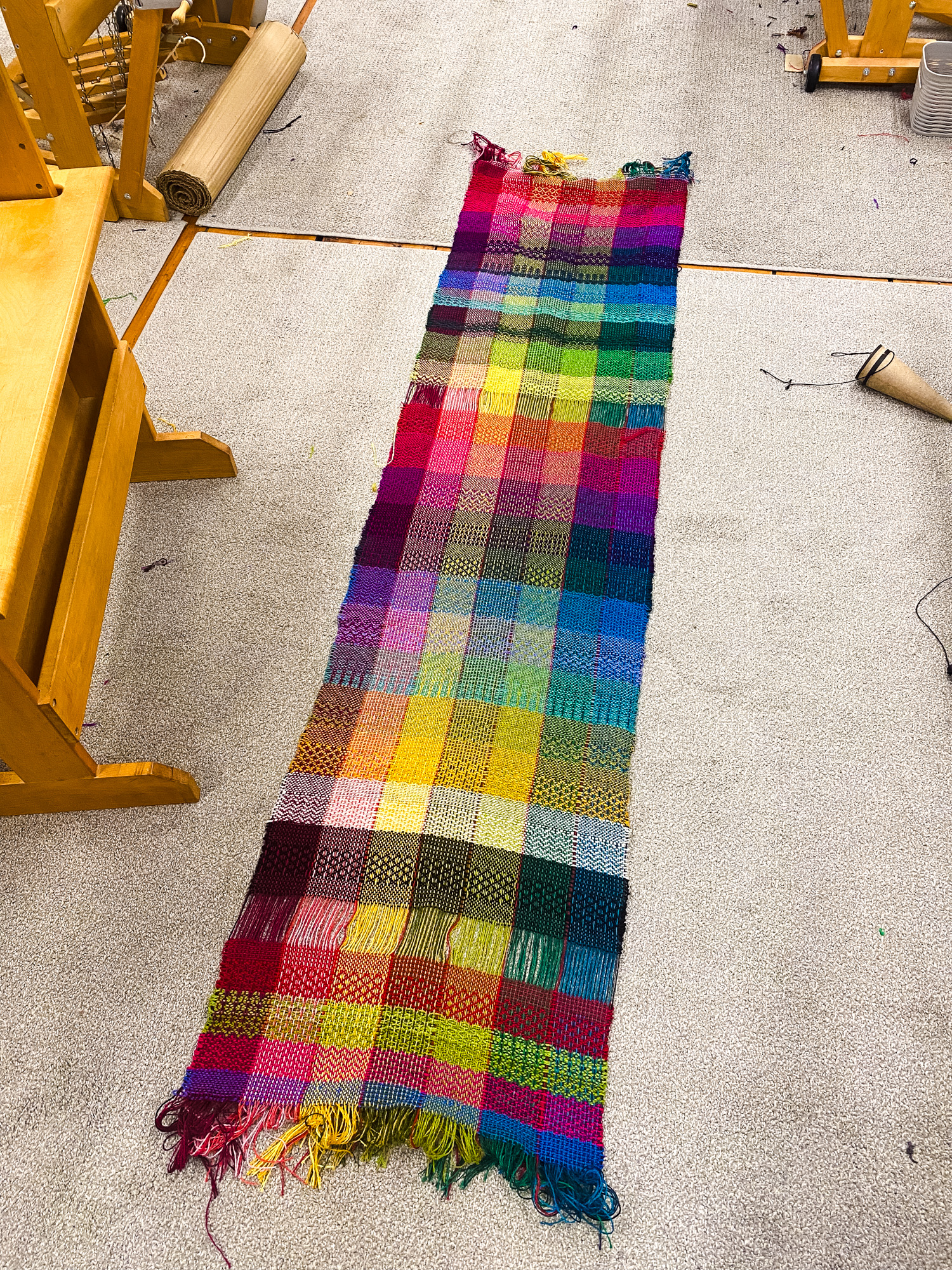
Throughout the week, I completed about four or five different samples. My two favorite were emulating a twill sampler Megan had woven and brought it, and the overshot sampler pictured above.
Overall, I had an amazing time. I came back refreshed and inspired, and I can’t wait to try other color experiments. I would love to do more large-scale, vibrantly colored overshot, as well as some more traditionally-sized, but still contemporary color variations. And some of these twill samples would make an amazing upholstery fabric…
Megan’s original samplerMy favorite square in the original samplerMy finished sampler
Over the past few months, I decided to plunge into processing fleece from scratch. Overall, I really enjoy it. Most of the fleeces I purchased have very little VM and are absolutely beautiful.
Washing fleece in the backyard
There is one that has quite a bit of VM, and is very greasy. That has not been as enjoyable, but the fleece itself is a very fine fawn and gray Shetland, so I think the final yarn will be amazing.
In order to process a lot of the solid/semi-solid colored fleece, I decided I wanted to invest in a drum carder. I ended up going with a medium-sized 96 TPI drum carder from a seller on Etsy. It was far less expensive than the “name brand” drum carders I’d seen, but had great reviews and so far it has been working well 🤞🏻 I definitely have to watch how much fleece I try to load on at once, and it is going to need some serious cleaning after this particularly dirty fleece.
In order to minimize the amount of VM going into my drum carder, I am doing a lot of hand picking – splitting the fleece apart over and over to shake loose the VM. But, there is a loooot, so there’s definitely still more than I would like getting on the carder.
I went with the 96 TPI after shooting Jen from Whispering Pines Farm an email to ask for her advice. The drum carder came in 72 and 96, and knowing I had two of her fleeces I wanted to process and treat gently, I asked for her TPI recommendation. She said the 96 would be a good option given I had both her fine fleeces, but also a few more primitive fleeces (a moorit Shetland and Hebridean).
At the moment, I have six(!) fleeces to process (and luckily I have a plan for all of them).
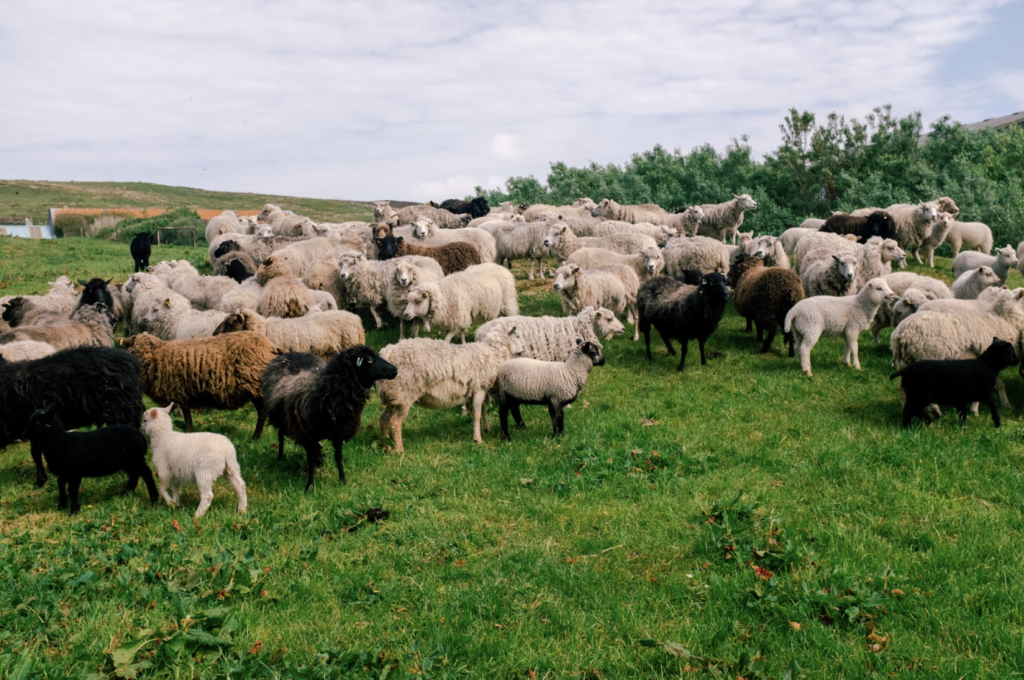
I have two fine Shetland fleeces from Whispering Pines Farm. I choose two black fleeces because I wanted to compare the color to a Hebridean fleece (which I found on Etsy from a U.K. seller with many breeds). One day, I would like to have a small flock, and I looooove Hebridean sheep and their fleece color. But, as far as I can tell, you cannot get them as livestock in the U.S. (and you cannot import livestock from the U.K. into the U.S.). So, I wanted to see how the black Shetland color compared. Now after seeing all three fleeces in person, I think a black primitive Shetland or Icelandic would be a much better fleece to compare to the Hebridean, so that will probably be next once I get through some of these.
Next, I have a moorit Shetland that falls in between very primitive and fine. It is not dual coated, but it is much closer to the Hebridean in texture and staple length. This fleece came from Ewereka Farm and is absolutely beautiful. It’s so clean, an amazing color, and I can’t wait to work on it.
I also have the fawn/gray Shetland fleece from a different Etsy seller, which I have mixed feelings about. Like I said before, the color and crimp is amazing, but it is very dirty and greasy (actually, so far I have found all the fine Shetland fleeces to be wayyy greasier). So, if you don’t mind a lot of VM, these might be good fleeces for you.
Lastly, I have an absolutely beautiful Jacob fleece. This was one of the more expensive fleeces, but it is huge and full of amazing shades. I plan to process this one differently from the rest – hand flick the locks and spin them for a marled yarn.
All-in-all, I’ve been really enjoying this new adventure and now that everything is washed, I’m looking forward to processing everything over the winter while stuck inside.